Home / SIP core: messages, transactions, dialogs / UDP, TCP, TLS, and WebSocket
UDP, TCP, TLS, and WebSocket
The transport is a property of the hop, written in Via, and it changes retransmission and framing rather than the SIP methods.
Learn in 5 minutes
- Match UDP, TCP, and TLS to their default ports
- Use Content-Length as the stream framing
- Read a teaching dial-peer and trusted list
Visual
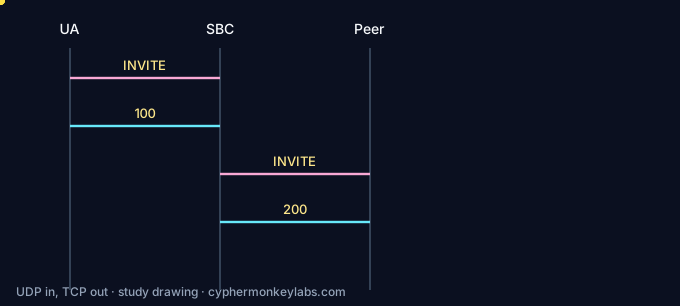
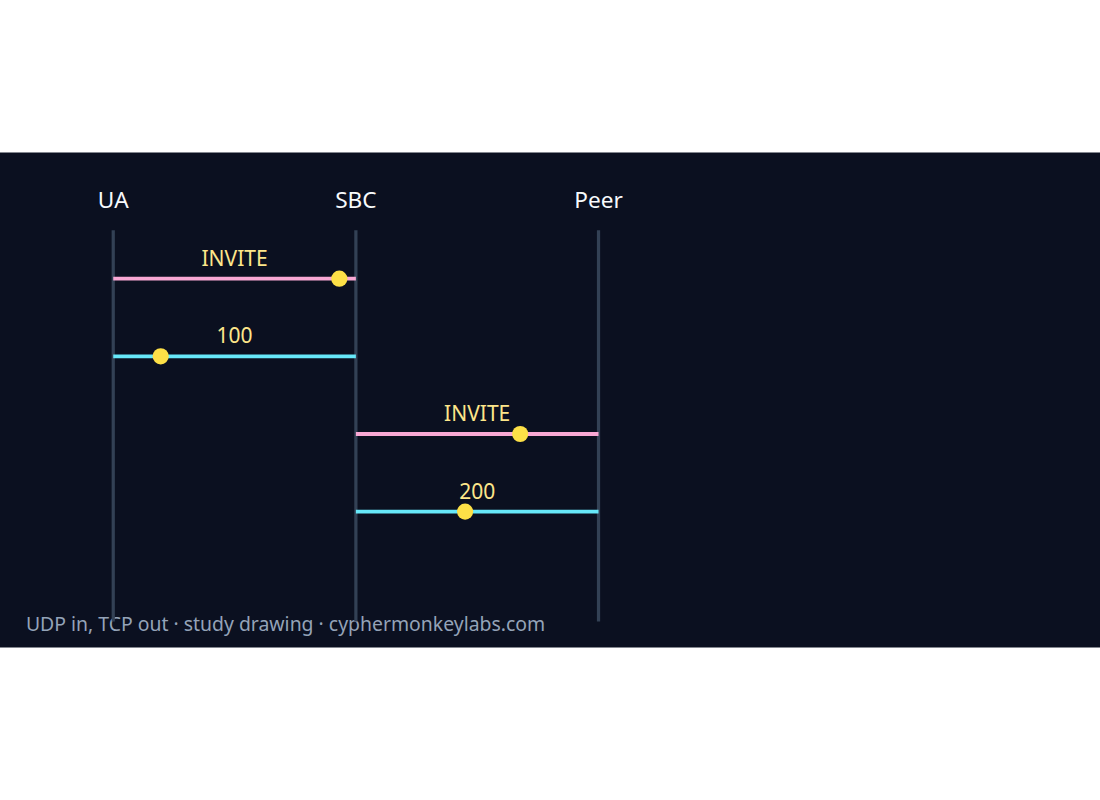
A proxy can receive UDP and send TCP. Each Via records the transport that hop actually used.
Worked example
Read the teaching config The config is a dial-peer, a trusted source, an empty profile, and one debug command.
- Find the session target.
- Find the trusted address.
- Name the command that prints SIP.
Fault
A proxy logs Timer A retransmissions for an INVITE whose top Via is TCP, and the peer sees duplicates.
Reliable transports rely on the connection. The SIP layer does not run Timer A.
Quiz
Ecosystem
Glossary, sister systems, and the integration seam for this room.
Workforce management WFM forecasts volume and builds schedules. It consumes contact-center events. It does not parse Via headers. When a forecast is wrong, the SIP symptom is usually queue delay and 480 or carrier congestion, not a broken dialog ID.
Programmable communications APIs Twilio’s docs home is API reference, tutorials, and integration for Twilio products. Elastic SIP Trunking is the SIP-shaped product already cited in this lab. This page does not define the word CPaaS from an RFC. Read the vendor page before you copy a diagram that uses that word.
Sources and go deeper
- RFC 3261 §18 — last checked 2026-10
- RFC 3581 — last checked 2026-10
- RFC 7118 — last checked 2026-10
- Cisco CUBE basic SIP configuration — last checked 2026-10
- Cisco CME toll-fraud prevention — last checked 2026-10
- RFC 3261 §17 — last checked 2026-10