Home / Registration, DNS, and routing / Loose routing and Max-Forwards
Loose routing and Max-Forwards
With lr, the Request-URI stays the remote target, each hop pops its own Route, and Max-Forwards of 0 yields 483.
Learn in 5 minutes
- Pop a top Route that names this hop
- Leave the Request-URI in place when lr is present
- Return 483 when Max-Forwards arrives as 0
Visual
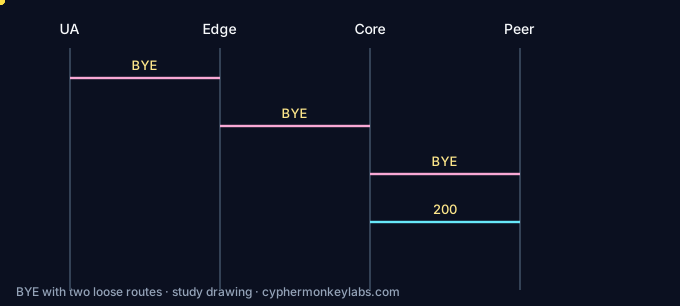
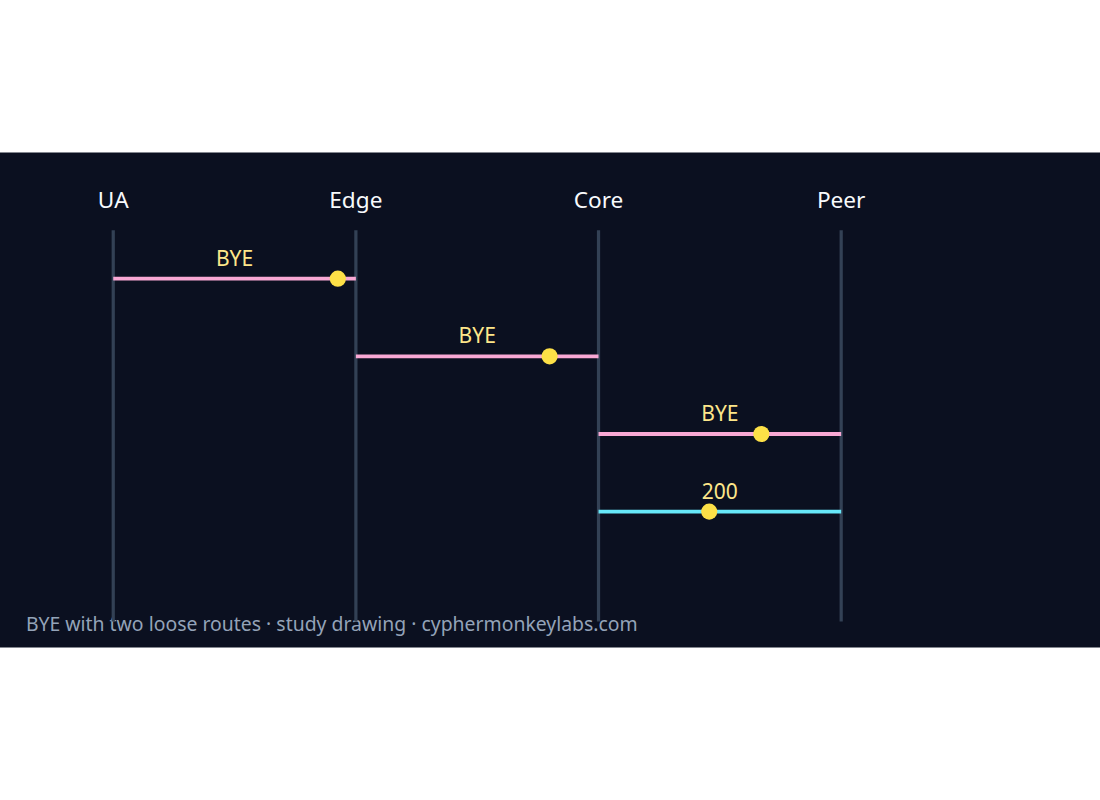
Route is the path. Max-Forwards is the budget. They are not substitutes.
Worked example
Watch Route shrink Compare the Route headers on the first and second BYE.
- Inspect the caller's BYE.
- Inspect Edge's BYE.
- Confirm the Request-URI host did not become the proxy.
Fault
A proxy receives an INVITE with Max-Forwards 0 and sends it on. The next proxy also forwards it. The loop never returns 483.
Zero means the budget is spent. Decrement happens only when the value is greater than zero and the proxy is actually forwarding.
Quiz
Ecosystem
Glossary, sister systems, and the integration seam for this room.
E911 / emergency calling Location has to ride with the call. RFC 6881 is the BCP, RFC 6442 carries location in SIP, and the FCC MLTS page states Kari’s Law and RAY BAUM’s Act obligations for multi-line systems.
Sources and go deeper
- RFC 3261 §16 — last checked 2026-10
- RFC 3261 §12 — last checked 2026-10
- RFC 3261 §8.1.1.6 — last checked 2026-10
- RFC 3261 §21 — last checked 2026-10