Home / TLS, SRTP, identity, and abuse / 401, 407, and digest
401, 407, and digest
A 401 from a UAS is answered with Authorization. A 407 from a proxy is answered with Proxy-Authorization.
Learn in 5 minutes
- Pair 401 with Authorization and WWW-Authenticate
- Pair 407 with Proxy-Authorization and Proxy-Authenticate
- Stop at the header split and do not compute an attack
Visual
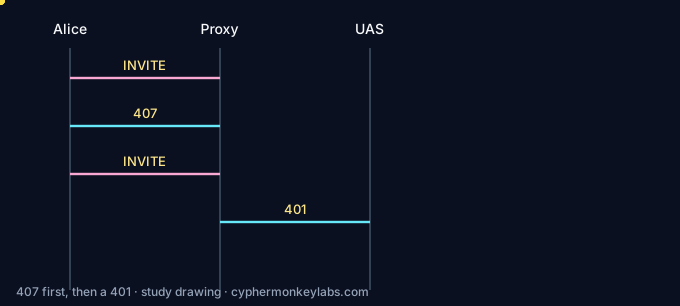
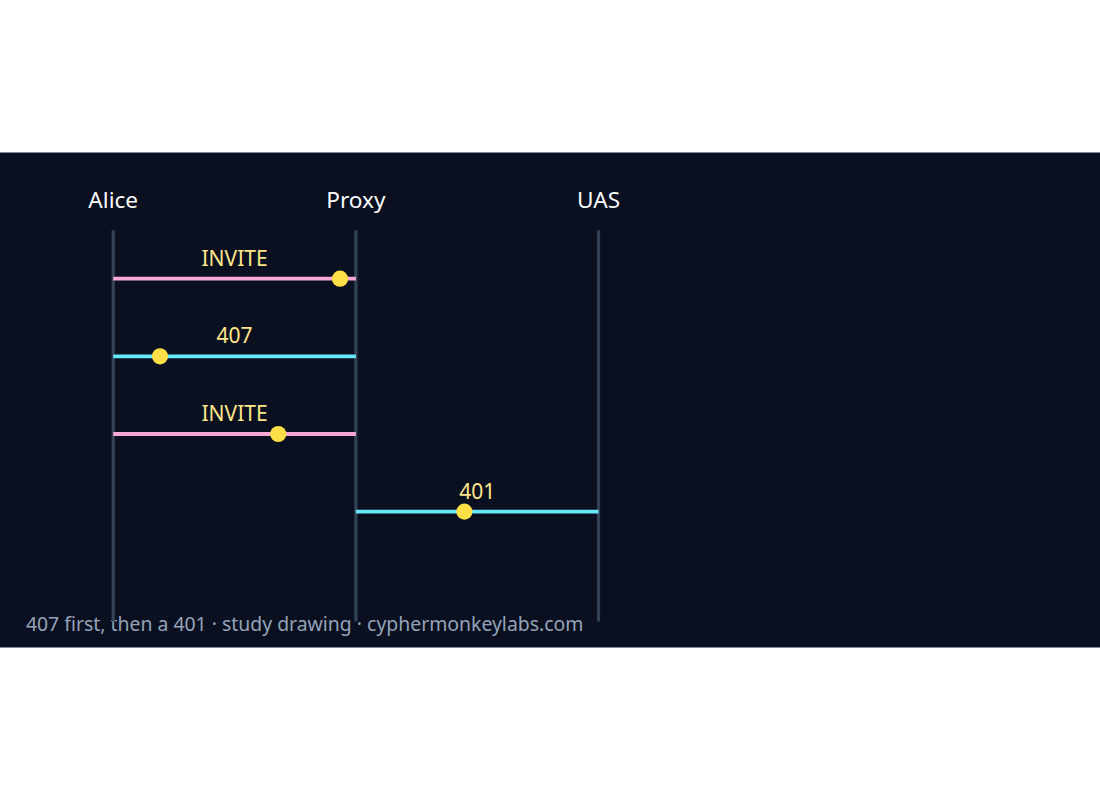
RFC 3261 section 22 is the SIP rule. RFC 7616 is the HTTP digest specification for algorithms.
Worked example
Read a 407 Dissect the 407. Name the challenge header and the header the client must send next.
- Press Dissect.
- Read the status line.
- Find Proxy-Authenticate and note there is no computed response.
Fault
A UAS returned 401 with WWW-Authenticate. The next INVITE adds only Proxy-Authorization, and the UAS challenges again.
RFC 3261 section 22 splits the UAS challenge from the proxy challenge.
Quiz
Ecosystem
Glossary, sister systems, and the integration seam for this room.
Workforce management WFM forecasts volume and builds schedules. It consumes contact-center events. It does not parse Via headers. When a forecast is wrong, the SIP symptom is usually queue delay and 480 or carrier congestion, not a broken dialog ID.
Sources and go deeper
- RFC 3261 §22 — last checked 2026-10
- RFC 7616 — last checked 2026-10