Home / Session border controllers / Active and standby, without a made-up timer
Active and standby, without a made-up timer
Active/standby is a product behavior. One unit owns the work and the other is ready. Timers belong in that product’s HA guide.
Learn in 5 minutes
- Describe active/standby at product level
- Keep failover timing out of the SIP RFC
- Expect dialog state to be a product problem
Visual
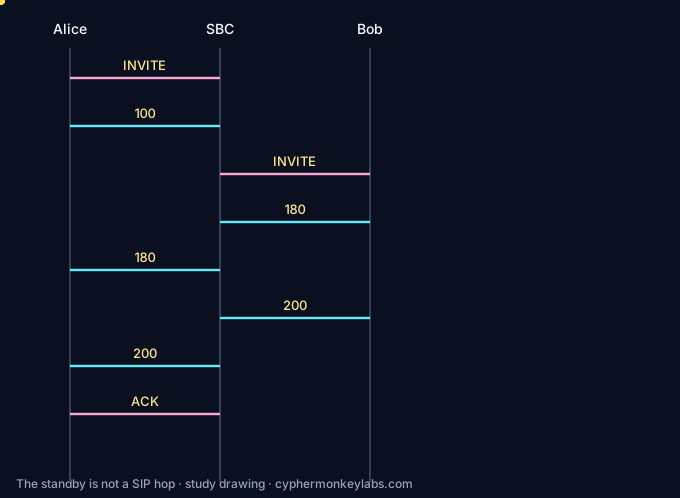
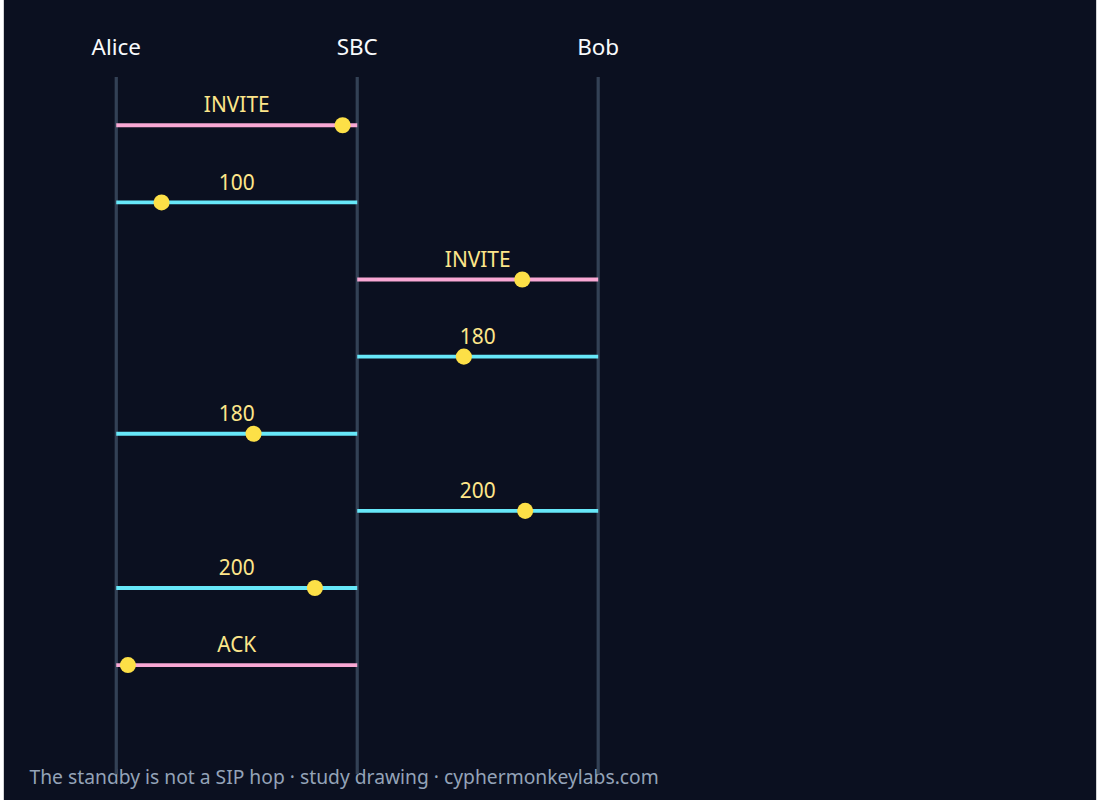
How fast the standby reacts is documented by the vendor.
Worked example
Count the SIP hops Play the call. How many SIP roles does the standby occupy in the ladder?
- Play all eight hops.
- Name each party.
- Notice the standby is not among them.
Fault
After the active unit stops responding, the standby does not own 203.0.113.20. The design used a failover timer taken from a different vendor’s blog.
The capture shows silence from the active address. It does not contain a universal timer.
Quiz
Ecosystem
Glossary, sister systems, and the integration seam for this room.
Workforce management WFM forecasts volume and builds schedules. It consumes contact-center events. It does not parse Via headers. When a forecast is wrong, the SIP symptom is usually queue delay and 480 or carrier congestion, not a broken dialog ID.
Programmable communications APIs Twilio’s docs home is API reference, tutorials, and integration for Twilio products. Elastic SIP Trunking is the SIP-shaped product already cited in this lab. This page does not define the word CPaaS from an RFC. Read the vendor page before you copy a diagram that uses that word.