Home / Cloud voice and CCaaS SIP / Teams Direct Routing signaling
Teams Direct Routing signaling
Direct Routing uses the pstnhub proxies on 5061, a certified SBC, and a verified domain. Contact must be an FQDN.
Learn in 5 minutes
- Name the three signaling FQDNs and port 5061
- Require a verified domain and an FQDN Contact
- Remember that connection aliasing is unsupported
Visual
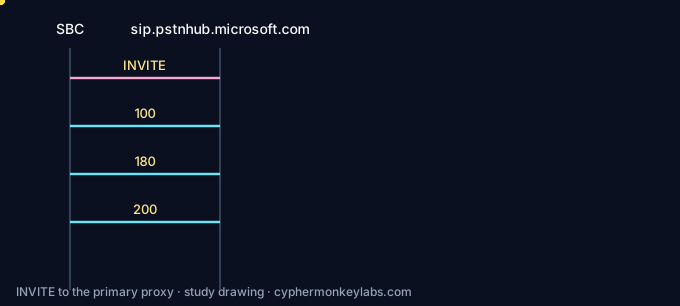
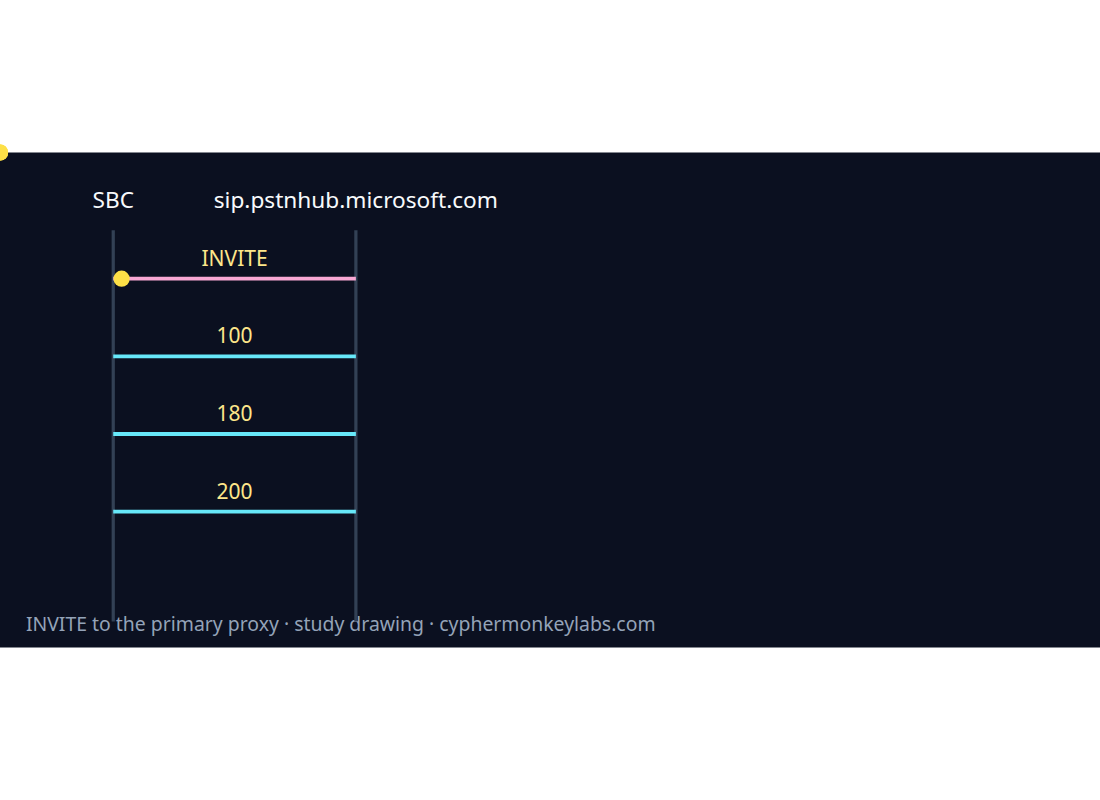
Checked against the plan and protocol articles.
Worked example
Check Contact and the proxy host Dissect the Direct Routing INVITE. Which host is in Contact?
Vendor menus, ports, and license names change. Confirm before relying on a sentence that is not an RFC.
Fault
The proxy answers 403 Forbidden. The INVITE was sent to sip.pstnhub.microsoft.com on 5061 with Contact sip:sbc@203.0.113.20.
The protocol article returns 403 when Contact is not an FQDN.
Quiz
Ecosystem
Glossary, sister systems, and the integration seam for this room.
Workforce management WFM forecasts volume and builds schedules. It consumes contact-center events. It does not parse Via headers. When a forecast is wrong, the SIP symptom is usually queue delay and 480 or carrier congestion, not a broken dialog ID.
Sources and go deeper
- Plan Direct Routing — last checked 2026-10
- Direct Routing SIP protocol — last checked 2026-10
- Direct Routing definitions and RFCs — last checked 2026-10
- RFC 5923 — last checked 2026-10