Home / Call authentication and compliance / Kari's Law, RAY BAUM'S Act, and SIP location
Kari's Law, RAY BAUM'S Act, and SIP location
Public Law 115-127 requires direct 911 dialing from MLTS. Section 506 of RAY BAUM'S Act requires a proceeding on dispatchable location. Educational only. Not legal advice.
Learn in 5 minutes
- State Kari's Law from the public law
- State the section 506 duty as a proceeding, and the statutory definition
- Keep RFC 6881 and RFC 6442 in the protocol column
Visual
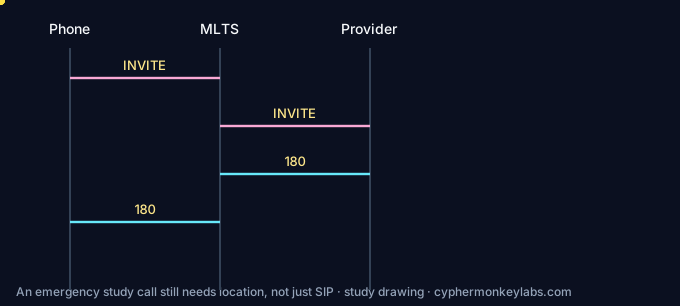
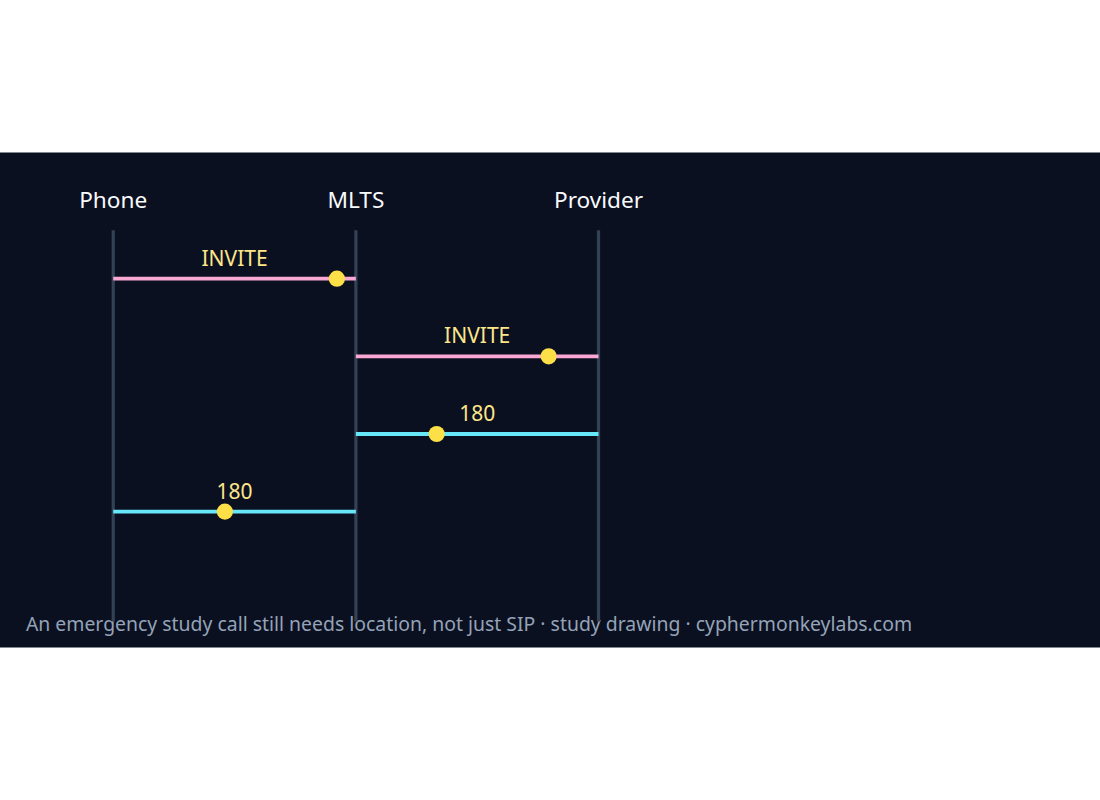
Dates below are the ones printed in the public laws this lab opened. This environment could not open the FCC MLTS page, so no implementation date from that page is listed.
Worked example
Which document Match the duty to the text. This is not a determination about a building.
- Read the three rows.
- Pick the statute for the extra-digit problem.
- Leave the SIP extension in the protocol row.
Fault
Users must dial 9 before 911. A test call to a lab number returns 200 OK. The ticket says Kari's Law is satisfied because SIP works.
Public Law 115-127 states the direct-dial configuration. This is not a ruling on any PBX.
Quiz
Ecosystem
Glossary, sister systems, and the integration seam for this room.
E911 / emergency calling Location has to ride with the call. RFC 6881 is the BCP, RFC 6442 carries location in SIP, and the FCC MLTS page states Kari’s Law and RAY BAUM’s Act obligations for multi-line systems.
Sources and go deeper
- Kari's Law Act of 2017, Public Law 115-127 — last checked 2026-10
- Public Law 115-141, RAY BAUM'S Act of 2018 — last checked 2026-10
- RFC 6881 — last checked 2026-10
- RFC 6442 — last checked 2026-10
- FCC MLTS 911 requirements — confirm