How models work · L1 · 15 min
Next-token prediction
Learn in five minutes
- The model assigns scores to possible next tokens.
- A fluent continuation is not a retrieved fact.
- Training predicts text. It does not by itself check your files.
- GPT-3's paper describes few-shot prompting of a large language model.
- Grounding is a separate step you add.
Ask a model a question about a note it was not given. If it answers smoothly, you still do not have evidence the note says that.
Visual
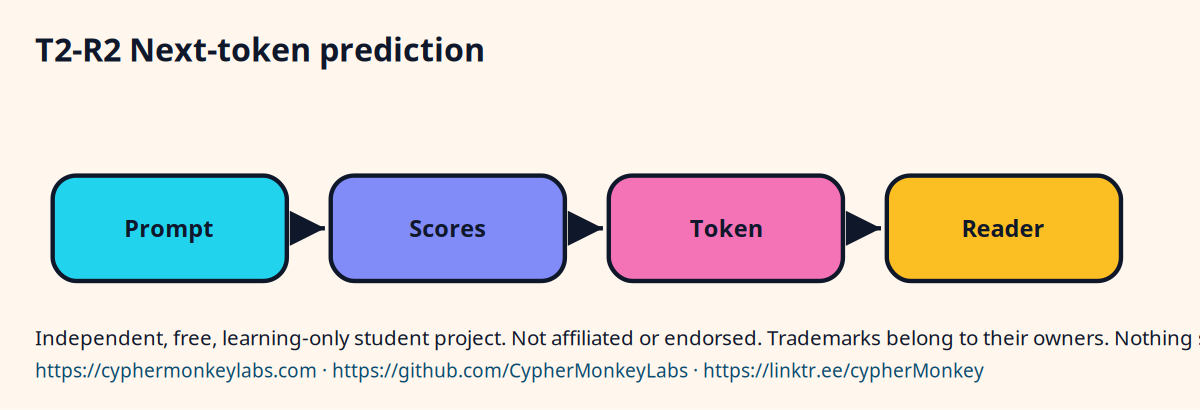
Prediction versus lookup
- Write a private sentence on paper and do not type it.
- Ask for that sentence's third word.
- Treat any answer as ungrounded. Then type the sentence and ask again, and still check the words yourself.
Quiz
Ecosystem
- Grounding
- Tying a claim to a passage you can open.
Sisters: Tokenizers, Transformers, Decoding, Model cards.
The same next-token idea sits under chat, voice, and tool calls.
Pin a model id when you leave the toy explanations.
Config
- Write the goal in one sentence.
- Name the input and the allowed output.
- Save the trace next to the result.
Troubleshooting
- The answer looks fluent and is wrong. Check whether a source passage actually contains the claim.
- The loop never stops. Set a step cap and stop when the tool result repeats.
Sources and go deeper
- Brown and co-authors, Language Models are Few-Shot Learners, 2020 paper last checked 2026-10
- Vaswani and co-authors, Attention Is All You Need, 2017 paper last checked 2026-10
- Large language model — Wikipedia wikipedia last checked 2026-10
- Attention Is All You Need — Wikipedia wikipedia last checked 2026-10