Retrieval · L2 · 20 min
Embeddings
Learn in five minutes
- An embedding is a list of numbers that stands for a text.
- Cosine similarity is a comparison, not an understanding.
- Dense passage retrieval is a cited approach for finding passages this way.
- A close vector can still be the wrong fact.
- Lab 06 shows a naive neighbor search missing a keyword hit. Read that result as a lesson, not a universal law.
Keep a keyword path beside the vector path until you have measured both on your notes. The lab's ablation is one fixture, not every corpus.
Visual
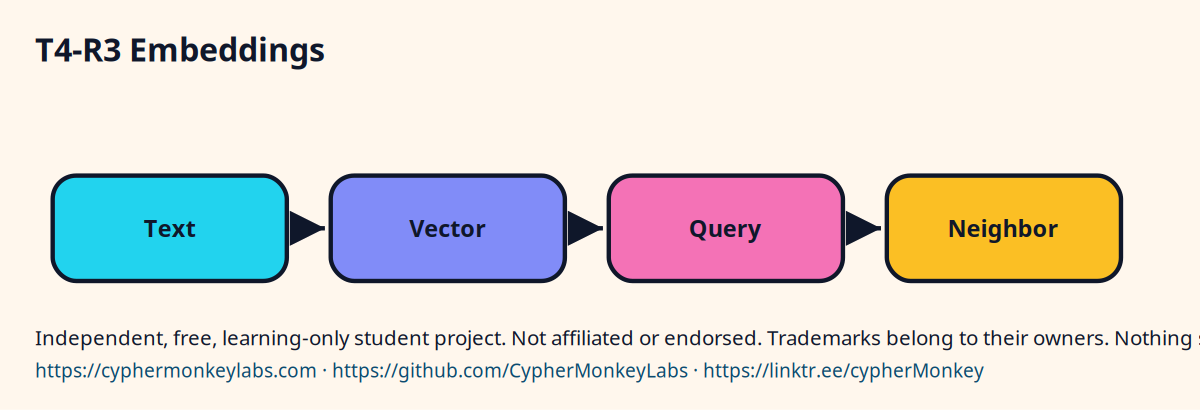
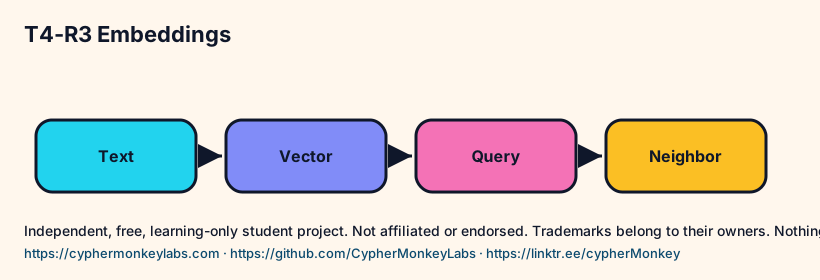
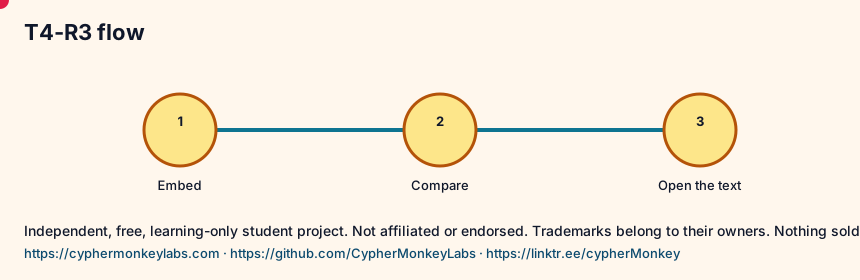
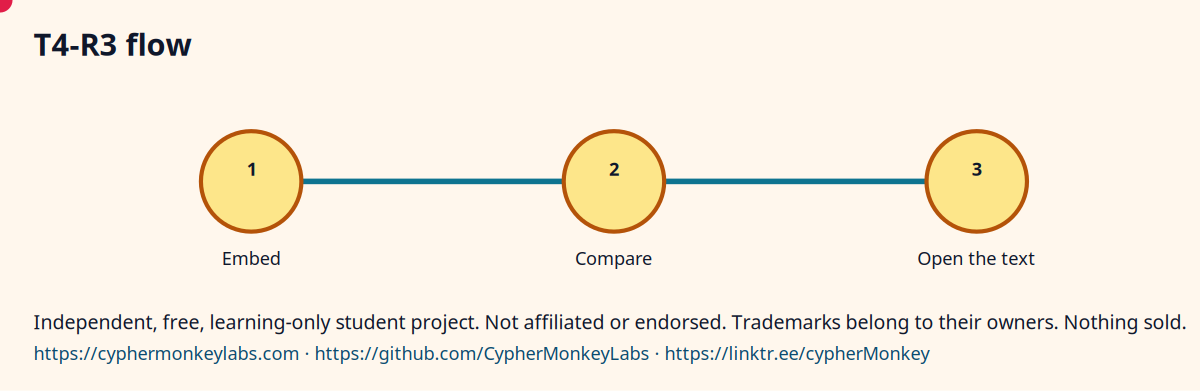
Two scores, one question
- Pick a question whose words appear in only one note.
- Score a keyword overlap and a toy vector if you have one.
- Write which one found the note.
- Do not generalize past that fixture.
Quiz
Ecosystem
- Embedding
- A numeric vector standing in for a piece of text.
Sisters: Search indexes, Embeddings, Rerankers, Citations.
A voice agent and a chat agent can share the same note index.
The capstone answers only from notes you are allowed to use.
Config
- Write the goal in one sentence.
- Name the input and the allowed output.
- Save the trace next to the result.
Troubleshooting
- The answer looks fluent and is wrong. Check whether a source passage actually contains the claim.
- The loop never stops. Set a step cap and stop when the tool result repeats.
Sources and go deeper
- Karpukhin and co-authors, Dense Passage Retrieval for Open-Domain Question Answering, 2020 paper last checked 2026-10
- Lewis and co-authors, Retrieval-Augmented Generation for Knowledge-Intensive NLP Tasks, 2020 paper last checked 2026-10
- Word embedding — Wikipedia wikipedia last checked 2026-10
- Retrieval-augmented generation — Wikipedia wikipedia last checked 2026-10