T3 · T3-R02
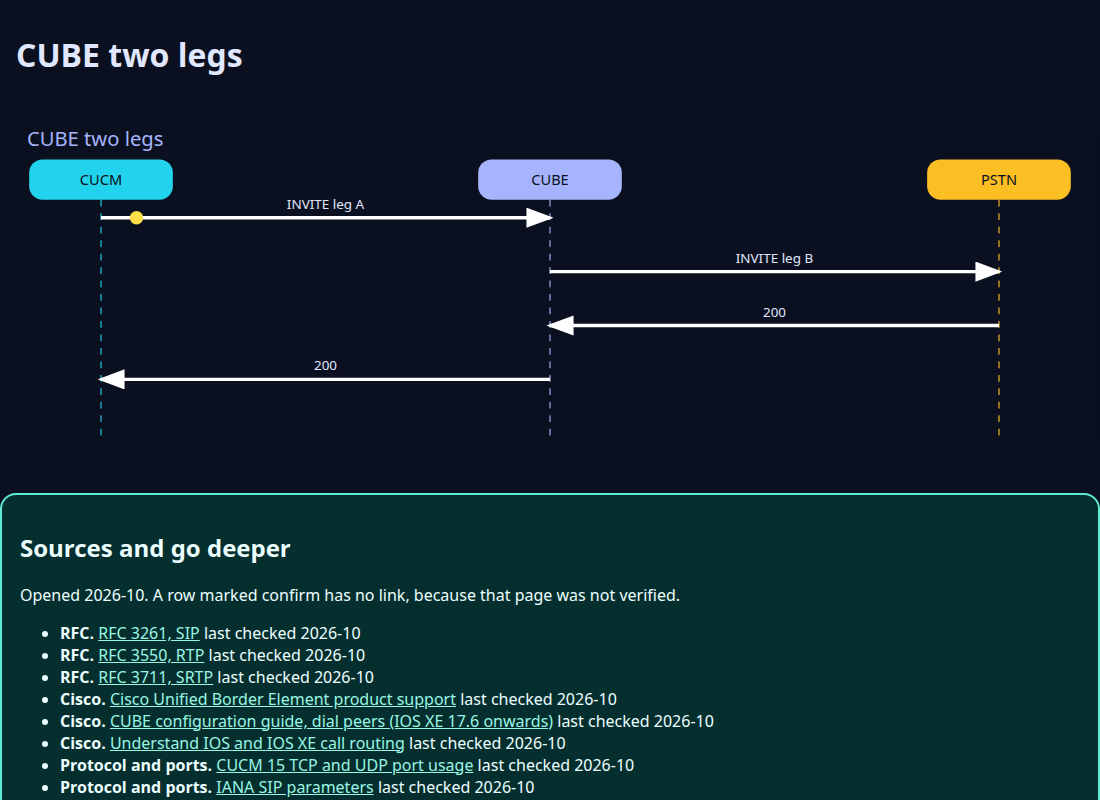
CUBE as a B2BUA
Learn it in 5 minutes
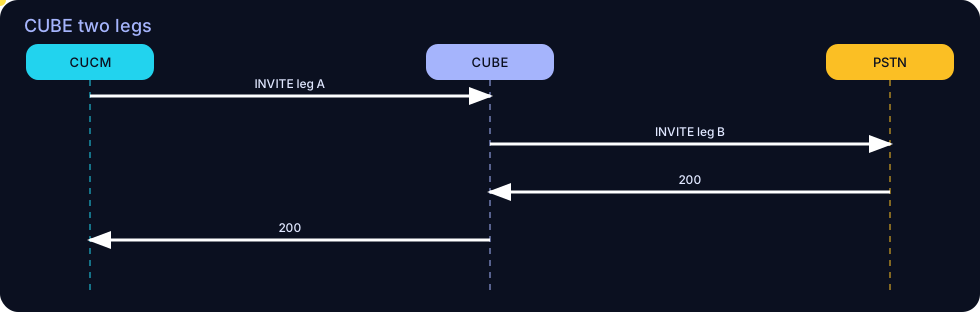
- CUBE terminates one dialog and starts another.
- Codec, DTMF, and header policies are per leg unless you bind them.
- Media can anchor on CUBE or flow around it, depending on the design.
- A 200 on the CUCM leg does not prove the carrier leg is up.
- Read IP addresses on each SDP.
Visual
What is going on
Unified Border Element is Cisco's SBC on IOS. Treat it as two calls. Mid-call services such as transfer and hold are re-INVITEs CUBE must map. If you only capture the CUCM side, you will miss a carrier rejection.
Confirm before relying. DSP and license names vary by platform. Confirm before you order hardware.
Worked example
CUCM sends G.711. The carrier peer allows G.729 only. CUBE can transcode if a DSP is configured and licensed for that feature. If not, the carrier leg fails and CUCM may see a different cause than 'no DSP'.
Quiz
1. CUBE forwards one SIP dialog unchanged, like a proxy.
False. It is a B2BUA.
Ecosystem
Sister pieces sit on the ecosystem page: the glossary, the mind map, the integration map, and the sibling labs.
- B2BUA — A user agent that sits between two dialogs.
- Media anchor — RTP terminates on the SBC.
Config. Show the inbound peer, the outbound peer, and whether a transcoder profile is bound.
Troubleshooting. Capture both legs. One ladder is not the call.
Bridge. The same CUBE can be a Webex Calling local gateway and a CUCM PSTN gateway. Those are different dial peers.
Mind map, sister technologies, and future hooks live on the ecosystem page.
Sources
Product screens move. Confirm the guide for your release before you change a live system.
Sources and go deeper
Opened 2026-10. A row marked confirm has no link, because that page was not verified.
- RFC. RFC 3261, SIP last checked 2026-10
- RFC. RFC 3550, RTP last checked 2026-10
- RFC. RFC 3711, SRTP last checked 2026-10
- Cisco. Cisco Unified Border Element product support last checked 2026-10
- Cisco. CUBE configuration guide, dial peers (IOS XE 17.6 onwards) last checked 2026-10
- Cisco. Understand IOS and IOS XE call routing last checked 2026-10
- Protocol and ports. CUCM 15 TCP and UDP port usage last checked 2026-10
- Protocol and ports. IANA SIP parameters last checked 2026-10
- Community. Cisco Community, Collaboration knowledge base last checked 2026-10
- Wikipedia. Session Initiation Protocol (Wikipedia) last checked 2026-10
- Wikipedia. English Wikipedia article for Cisco Unified Border Element. confirm. That title returned HTTP 404. last checked 2026-10
- RFC. RFC 4733, RTP telephony events last checked 2026-10
- RFC. RFC 4566, SDP last checked 2026-10