T5 · T5-R02
LLQ and the delay budget
Learn it in 5 minutes
- Priority queue bandwidth is a limiter for the EF class.
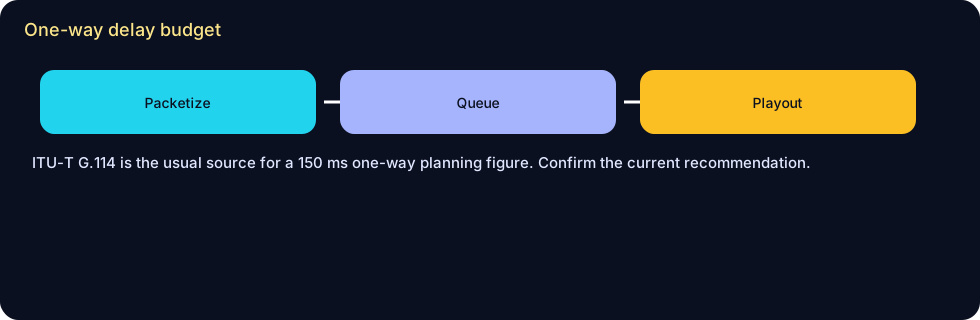
- Serialization, queuing, propagation, packetization, and jitter buffer all add delay.
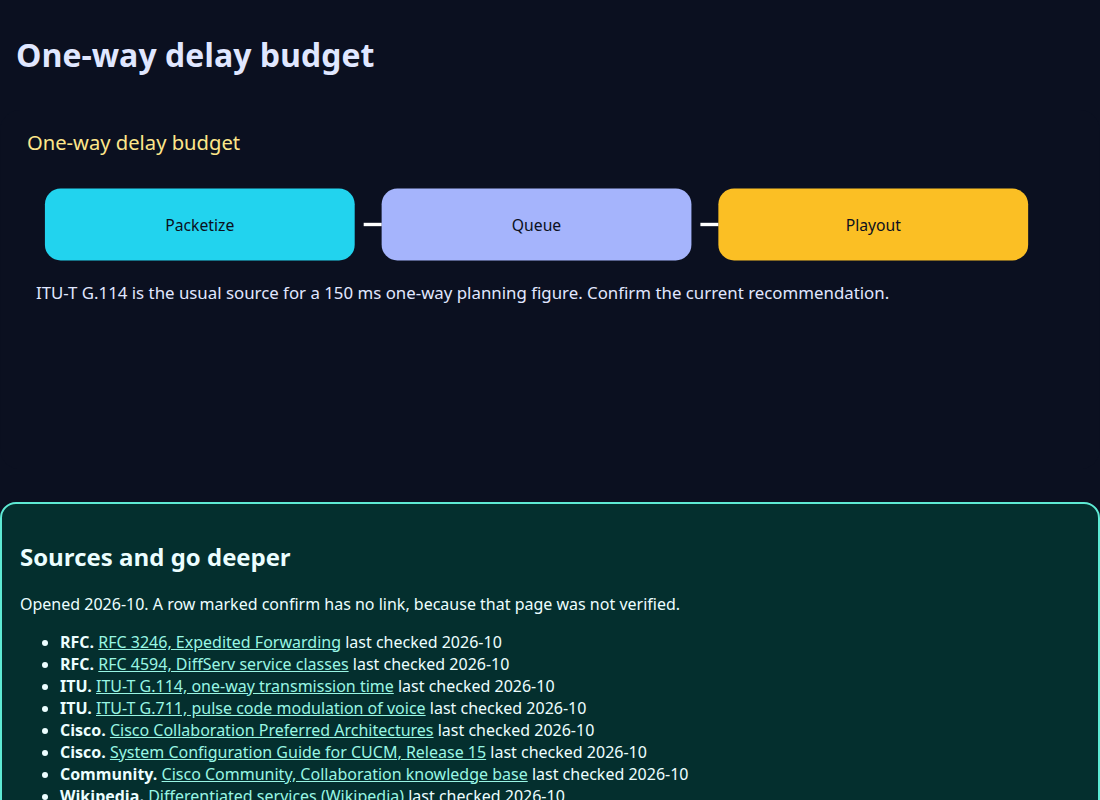
- ITU-T G.114 is the usual citation for a 150 ms one-way planning target.
- A queue cannot create bandwidth the circuit does not have.
- Confirm the current ITU text before you treat 150 ms as a contract.
Visual
What is going on
G.711 at 20 ms is about 80 kbit/s at layer 3 and about 87.2 kbit/s with an 18-byte Ethernet header. The formula is (payload + 40 + layer-2) times 8 times packets per second, then divide by 1000 for kbit/s. Size the priority class from calls you allow, not from a feeling.
Confirm before relying. Confirm the current G.114 text. The 150 ms figure is the classic planning number, not a promise about your carrier.
Worked example
Twenty G.711 calls want about 1.6 Mbit/s at layer 3 before overhead. A priority statement of 512 kbit/s will drop or delay the rest. Users hear it as clipping, not as a SIP error.
Quiz
1. LLQ adds bandwidth to a circuit.
False. It schedules the bandwidth you already have.
Ecosystem
Sister pieces sit on the ecosystem page: the glossary, the mind map, the integration map, and the sibling labs.
- LLQ — A queue that serves a priority class up to a configured rate.
- Packetization — The time to fill one RTP payload.
Config. Write the class rate next to the number of calls.
Troubleshooting. If signaling succeeds and MOS collapses only at busy hour, look at drops in the priority class.
Bridge. CAC in CUCM can limit calls so the queue is not overrun. QoS and CAC are partners.
Mind map, sister technologies, and future hooks live on the ecosystem page.
Sources
Product screens move. Confirm the guide for your release before you change a live system.
Sources and go deeper
Opened 2026-10. A row marked confirm has no link, because that page was not verified.
- RFC. RFC 3246, Expedited Forwarding last checked 2026-10
- RFC. RFC 4594, DiffServ service classes last checked 2026-10
- ITU. ITU-T G.114, one-way transmission time last checked 2026-10
- ITU. ITU-T G.711, pulse code modulation of voice last checked 2026-10
- Cisco. Cisco Collaboration Preferred Architectures last checked 2026-10
- Cisco. System Configuration Guide for CUCM, Release 15 last checked 2026-10
- Community. Cisco Community, Collaboration knowledge base last checked 2026-10
- Wikipedia. Differentiated services (Wikipedia) last checked 2026-10
- Wikipedia. Quality of service (Wikipedia) last checked 2026-10
- Cisco. Enterprise QoS SRND book. confirm. The Enterprise QoS SRND path returned HTTP 404. last checked 2026-10