T1 · T1-R01
SIP transactions and dialogs
Learn it in 5 minutes
- A transaction pairs a request with its responses.
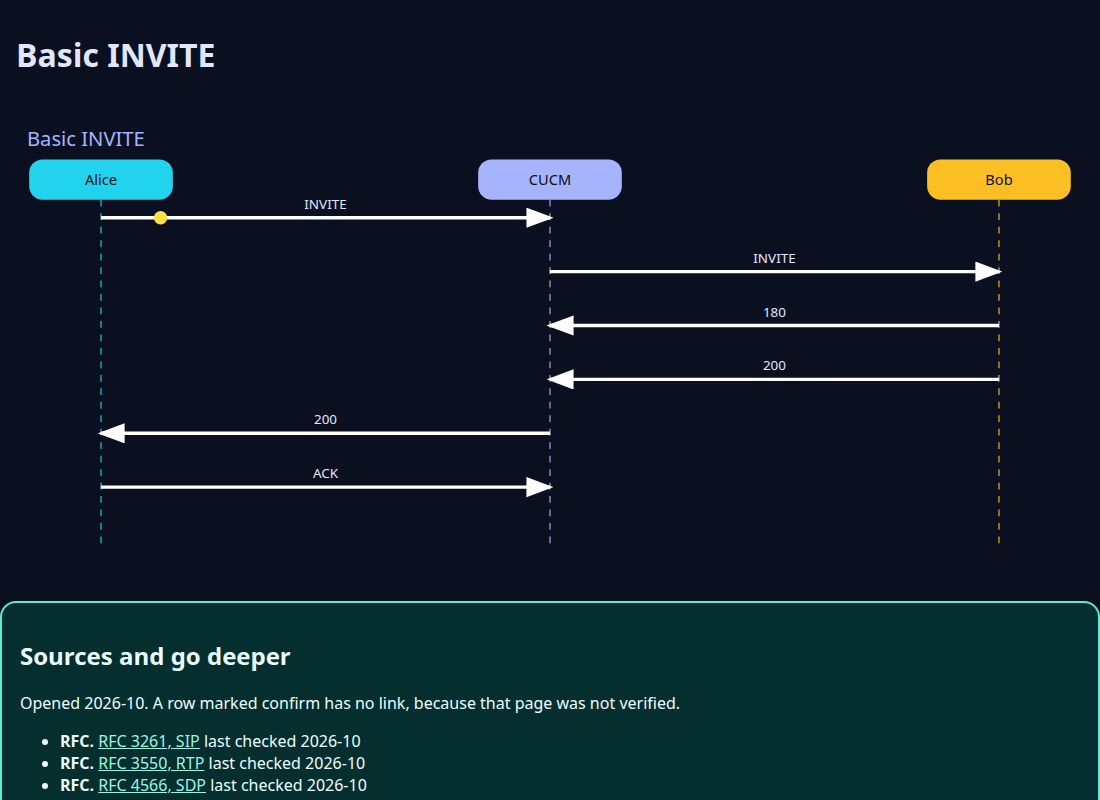
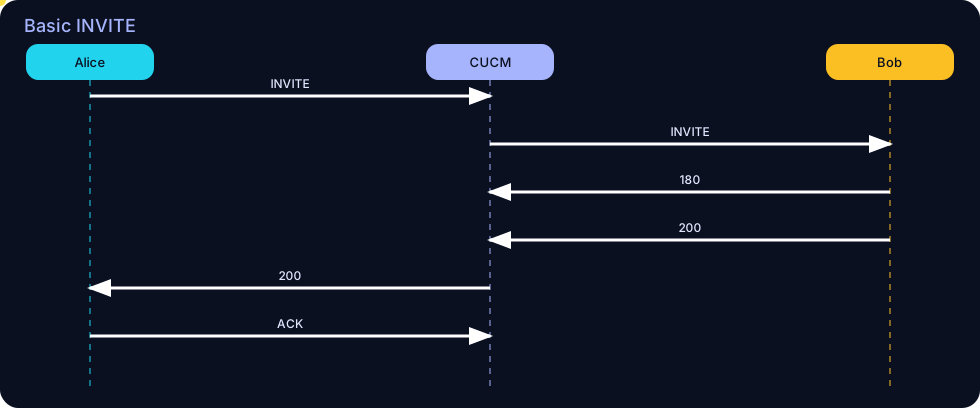
- INVITE, its final response, and the ACK for a 2xx are how a call is accepted.
- A dialog needs a Call-ID and both tags. A 100 Trying has no To tag.
- BYE ends that dialog.
- RTP does not have to follow the proxy that forwarded the INVITE.
Visual
What is going on
RFC 3261 separates transactions from dialogs. People debug the wrong object when a retransmitted 200 is treated as a second call, or when a To tag on a 180 is treated as an answer. The 180 means alerting. The 200 means the far end accepted the session. ACK completes that handshake for a 2xx. Media can start once offer and answer are known, which is often the 200, and the packets may go directly between the endpoints.
Worked example
A phone sends INVITE through CUCM. CUCM is a back-to-back user agent in this path, so you may see two Call-IDs. On each leg, find the branch, the CSeq, and the tags before you decide the call failed.
Quiz
1. A 180 Ringing means the call was answered.
False. It means alerting. The 200 accepts the session.
2. ACK for a 2xx is optional.
False. Without ACK the far end retransmits the 200 and can drop the call.
Ecosystem
Sister pieces sit on the ecosystem page: the glossary, the mind map, the integration map, and the sibling labs.
- Transaction — A request and its matching responses.
- Dialog — A peer relationship identified by Call-ID and tags.
Config. On a ladder, write the method, status, CSeq, and tags for one leg only.
Troubleshooting. If the 200 repeats, look for a missing ACK before you look at QoS.
Bridge. CUCM, CUBE, and a carrier SBC can each be a B2BUA. Count the dialogs.
Mind map, sister technologies, and future hooks live on the ecosystem page.
Sources
Product screens move. Confirm the guide for your release before you change a live system.
Sources and go deeper
Opened 2026-10. A row marked confirm has no link, because that page was not verified.
- RFC. RFC 3261, SIP last checked 2026-10
- RFC. RFC 3550, RTP last checked 2026-10
- RFC. RFC 4566, SDP last checked 2026-10
- Cisco. Cisco Unified Communications Manager product support last checked 2026-10
- Cisco. System Configuration Guide for CUCM, Release 15 last checked 2026-10
- Protocol and ports. CUCM 15 TCP and UDP port usage last checked 2026-10
- Protocol and ports. IANA SIP parameters last checked 2026-10
- Protocol and ports. IANA RTP parameters last checked 2026-10
- Community. Cisco Community, Collaboration knowledge base last checked 2026-10
- Wikipedia. Session Initiation Protocol (Wikipedia) last checked 2026-10
- Wikipedia. Real-time Transport Protocol (Wikipedia) last checked 2026-10
- Cisco. Collaboration 12 SRND book. confirm. The historical Collaboration 12 SRND path opened as a product listing, not the design book. Use the Preferred Architecture index, which was opened. last checked 2026-10
- RFC. RFC 3264, offer/answer last checked 2026-10