T11 · T11-R03
WebRTC, SIP over WebSocket, and a hosted bridge
Learn it in 5 minutes
- Wikipedia describes WebRTC as browser and mobile APIs for real-time audio and video without a plugin.
- The W3C WebRTC recommendation is the browser API. RFC 8825 is the IETF overview of the protocol suite those browsers use.
- RFC 8829, JSEP, lets a JavaScript application control the signaling plane through RTCPeerConnection. It discusses how that relates to existing signaling protocols.
- RFC 7118 carries SIP over a WebSocket so a web application can use SIP as the signaling.
- The FreeSWITCH manual opened here says SignalWire runs that engine as a hosted platform with REST APIs. That is one bridge from open telephony to a cloud API. It is not a catalog of every CPaaS.
Visual
What is going on
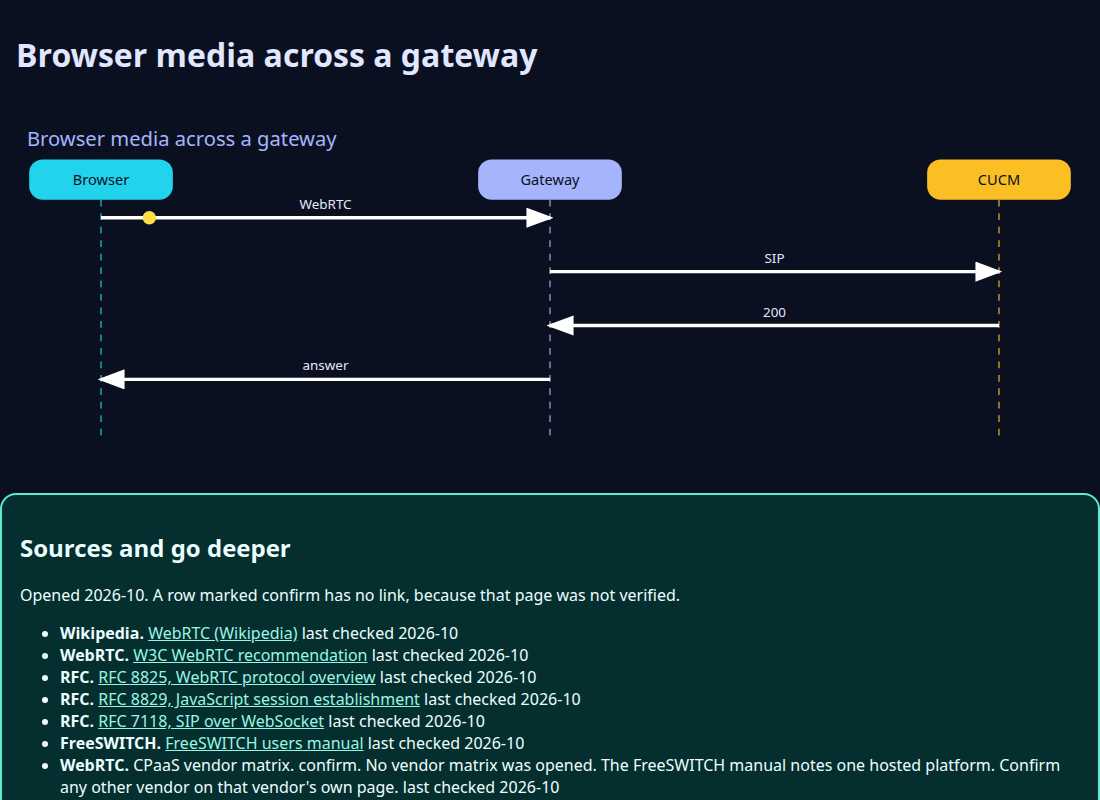
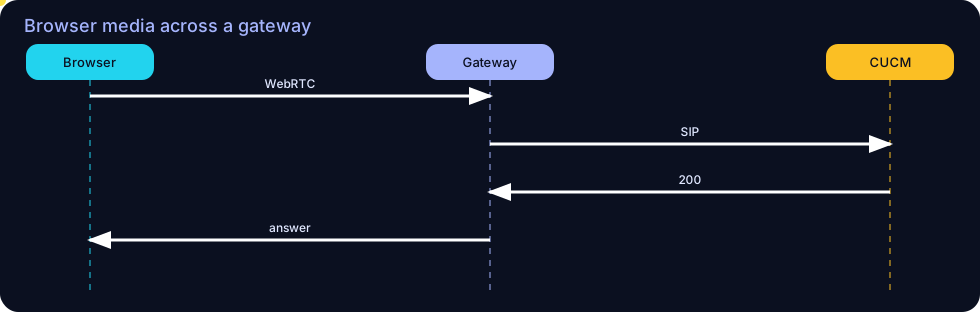
A browser does not register to CUCM just because both can carry voice. WebRTC media and SIP dialogs meet at a gateway, a PBX that speaks both, or a service that translates them. ICE, which the Wikipedia article names, is how the browser finds a path. It is not a CUCM partition. JSEP is how the page drives offer and answer. SIP over WebSocket is one way to keep SIP as the signaling instead of inventing a new call model. A communications API that places a call for you is a further hop. This lab opened one statement of that idea, in the FreeSWITCH manual's note on SignalWire. It did not open a vendor matrix, so the matrix stays on a confirm row with no link.
Confirm before relying. A full CPaaS product matrix was not opened. Confirm any vendor claim on that vendor's own page.
Worked example
A web page establishes a PeerConnection to a gateway. The gateway sends a SIP INVITE to CUCM. CUCM rings a desk phone. If you capture only on CUCM you will see SIP and miss the browser's ICE candidates. If you capture only in the browser you will not see the CUCM route pattern. Save both sides.
Quiz
1. A WebRTC page is a CUCM SIP phone.
False. Something has to translate, unless the far end also speaks WebRTC.
2. RFC 8829 replaces SIP.
False. It describes JavaScript control of the signaling plane and how that relates to existing signaling.
Ecosystem
Sister pieces sit on the ecosystem page: the glossary, the mind map, the integration map, and the sibling labs.
- WebRTC — Browser real-time communication. The W3C recommendation is the API. RFC 8825 points at the protocol suite.
- JSEP — JavaScript Session Establishment Protocol, RFC 8829.
Config. Name the gateway that translates, and which side speaks SIP.
Troubleshooting. One-way audio here is still SDP and ICE. A 200 on the SIP leg does not prove the browser received RTP.
Bridge. Expressway is a Cisco edge. A WebRTC gateway is a different edge. Do not mix the port lists.
Mind map, sister technologies, and future hooks live on the ecosystem page.
Sources
- WebRTC (Wikipedia)
- W3C WebRTC recommendation
- RFC 8825, WebRTC protocol overview
- RFC 8829, JavaScript session establishment
- RFC 7118, SIP over WebSocket
- FreeSWITCH users manual
Product screens move. Confirm the guide for your release before you change a live system.
Sources and go deeper
Opened 2026-10. A row marked confirm has no link, because that page was not verified.
- Wikipedia. WebRTC (Wikipedia) last checked 2026-10
- WebRTC. W3C WebRTC recommendation last checked 2026-10
- RFC. RFC 8825, WebRTC protocol overview last checked 2026-10
- RFC. RFC 8829, JavaScript session establishment last checked 2026-10
- RFC. RFC 7118, SIP over WebSocket last checked 2026-10
- FreeSWITCH. FreeSWITCH users manual last checked 2026-10
- WebRTC. CPaaS vendor matrix. confirm. No vendor matrix was opened. The FreeSWITCH manual notes one hosted platform. Confirm any other vendor on that vendor's own page. last checked 2026-10