T1 · T1-R03 · Zoom Workplace
Zoom API access, one hour at a time
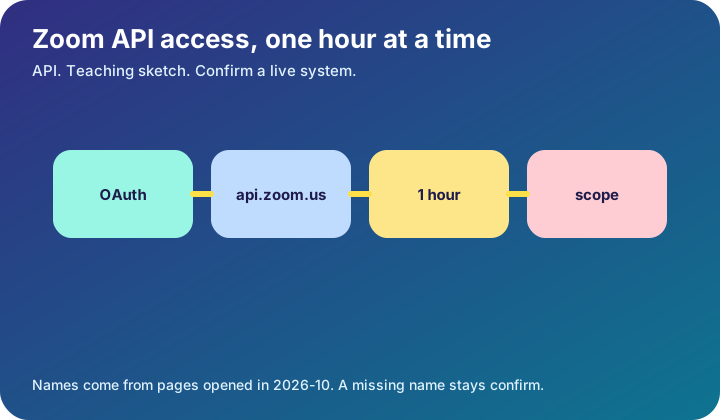
Account-wide automation and a user-consented app are different grants. The page says OAuth uses an authorization code that you exchange for a token, and server-to-server OAuth uses app credentials to request a token directly. Refresh the user token, or request a new server-to-server token, when the hour ends.
Learn it in 5 minutes
- The API reference says to obtain an access token with OAuth or server-to-server authentication.
- Requests go to the base URL https://api.zoom.us/v2/ with the token in the Authorization header.
- Methods named on that page are GET, POST, PATCH, PUT, and DELETE.
- The page says both OAuth styles provide access tokens valid for one hour.
- The sample token response on the page includes expires_in 3599.
Visual
Count the boxes: 4. Each label is a name from a page or a study label marked on the drawing.
Flow
What is going on
Account-wide automation and a user-consented app are different grants. The page says OAuth uses an authorization code that you exchange for a token, and server-to-server OAuth uses app credentials to request a token directly. Refresh the user token, or request a new server-to-server token, when the hour ends.
The sample is an illustration on the docs page. It is not a credential. This lab does not store client secrets, and you should not paste one into a study note.
Workplace and Zoom CX both appear in the API navigation. A token's scope, shown in the sample as a field named scope, decides what that token can call. The sample value user:read is an example on the page, not your app's scope.
Worked example
Write the base URL, the header name, and the lifetime you read (one hour, and the sample expires_in 3599). Stop before you invent a scope. Open your app's scope list in the Zoom console you administer, which this lab cannot see.
Quiz
1. The API reference sample shows expires_in 3599.
True. That number is in the sample response on the page that opened.
2. A study note should include a client secret so the next reader can call the API.
False. The page tells you to obtain a token. It does not ask you to publish a secret.
Ecosystem
Sister pieces sit on the ecosystem page: the glossary, the mind map, the integration map, and the bridges.
- Access token — The credential the Zoom API reference says to send in the Authorization header.
- Server-to-server OAuth — The grant the page describes for requesting a token with app credentials, without a user consent code.
Config. Record the base URL and the grant type. Leave the secret in the admin console.
Troubleshooting. A call that worked an hour ago and now returns an auth error matches the lifetime the page states. Refresh before you blame the dial plan.
Bridge. Phone, Contact Center, and Virtual Agent docs sit on the same developer site. They still name their own guides.
Mind map, sister technologies, and future hooks live on the ecosystem page.
Sources and go deeper
Opened 2026-10. A row marked confirm has no link, because that page was not verified.
- Zoom. Zoom API reference last checked 2026-10
- Zoom. Zoom Phone developer documentation last checked 2026-10
- Zoom. Zoom compliance page last checked 2026-10
- Confirm. Your app's live scope list. confirm. The sample scope is not your tenant. last checked 2026-10