T8 · T8-R24 · Webhooks and IVR
A ladder you are allowed to draw
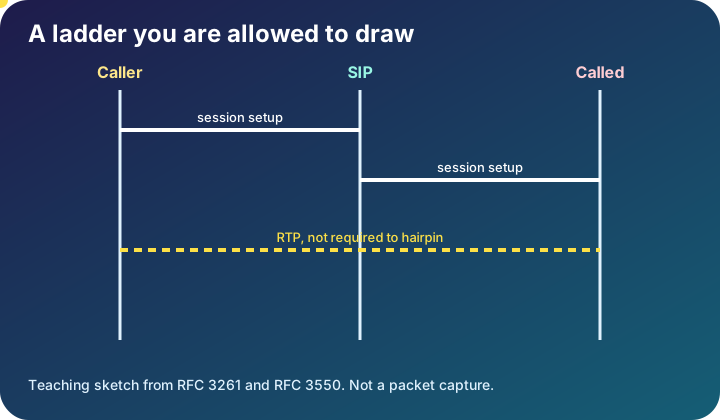
Put the arrows in an order you can defend. Registration and session setup, then media, and in parallel the HTTP event to your application if the platform is programmable. Media Streams are a third path: media copied to a WebSocket, named on Twilio's voice navigation. This session did not open the WebSocket message schema, so the field list stays confirm.
Counts on this page
Opened sources
Confirm rows, no URL
Learn it in 5 minutes
- SIP sets up the session. RTP carries the media. The webhook tells your app that something happened.
- Twilio's voice docs also name Media Streams and a WebSocket for consuming a real-time stream.
- Bandwidth returns 202 when a message is queued, then a delivered or failed webhook.
- A SIP trunk's private and public domains still apply when the IVR is hosted.
- No customer packet capture was opened. Every ladder in this lab is a teaching sketch.
Visual
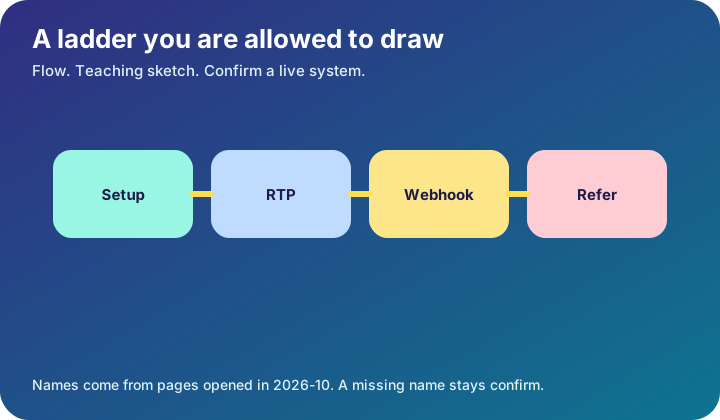
Count the boxes: 4. Each label is a name from a page or a study label marked on the drawing.
Flow
What is going on
Put the arrows in an order you can defend. Registration and session setup, then media, and in parallel the HTTP event to your application if the platform is programmable. Media Streams are a third path: media copied to a WebSocket, named on Twilio's voice navigation. This session did not open the WebSocket message schema, so the field list stays confirm.
Do not draw a transfer unless you have a verb. Twilio lists Refer and Dial. A warm transfer's exact header sequence was not copied from an RFC in this room. RFC 3261 is the signaling specification. A vendor's transfer tutorial was not opened, so the click path is confirm.
Worked example
Sketch: caller, platform, your webhook, agent. SIP between caller and platform, RTP as a dashed line that need not hairpin, HTTP from the platform to your app. Stop. Add Refer only as a named verb, not as a captured call.
Quiz
1. This lab's ladders are teaching sketches, not a customer packet capture.
True. No capture was opened.
2. Media Streams' WebSocket field list was copied into this room.
False. The feature is named. The schema was not opened.
Ecosystem
Sister pieces sit on the ecosystem page: the glossary, the mind map, the integration map, and the bridges.
- Media Streams — The Twilio voice feature named for sending live audio to a WebSocket. The message schema was not opened.
- Refer — A TwiML verb on the voice page. Not, by itself, a full transfer tutorial.
Config. One flow, one page citation per arrow.
Troubleshooting. Audio in one direction: RTP and NAT, from the media room. A missing menu: the webhook and Gather. Do not swap those fixes.
Bridge. LiveKit telephony adds a SIP participant into a room. That is a later bridge, not this ladder.
Mind map, sister technologies, and future hooks live on the ecosystem page.
Sources and go deeper
Opened 2026-10. A row marked confirm has no link, because that page was not verified.
- RFC. RFC 3261, SIP last checked 2026-10
- RFC. RFC 3550, RTP last checked 2026-10
- Twilio. Introduction to Webhooks last checked 2026-10
- Twilio. Programmable Voice last checked 2026-10
- Bandwidth. Bandwidth Messaging API last checked 2026-10
- Wikipedia. SIP trunking last checked 2026-10
- Confirm. A captured transfer ladder. confirm. last checked 2026-10
- Confirm. Twilio Media Streams message fields. confirm. last checked 2026-10