T3 · T3-R07 · Numbers and trunks
E.164 numbers and direct inward dial
Fifteen digits is the maximum the E.164 article states. It is not a promise that every platform stores fifteen digits, and it is not a price. The ITU page's in-force label is E.164 (02/26). A vendor's number-ordering screen was not that recommendation.
Counts on this page
Opened sources
Confirm rows, no URL
Learn it in 5 minutes
- Wikipedia says E.164 is the ITU-T recommendation titled The international public telecommunication numbering plan.
- It says plan-conforming numbers use only digits and a maximum of fifteen digits, with a country code of one to three digits.
- The ITU page that opened lists E.164 (02/26), The international public telecommunication numbering plan, as an in-force component.
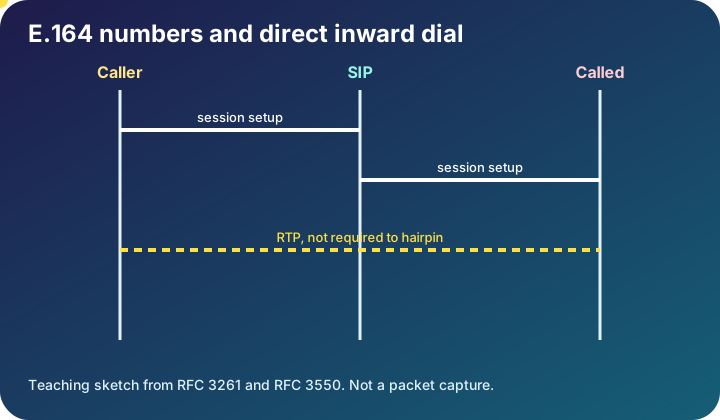
- Direct inward dial, on its article, is a service for PBX subscribers: many numbers over trunks, and the dialed number is transmitted so an extension can be reached directly.
- The same article says the dialed number is signaled with DNIS, often in a partial format such as the last four digits.
Visual
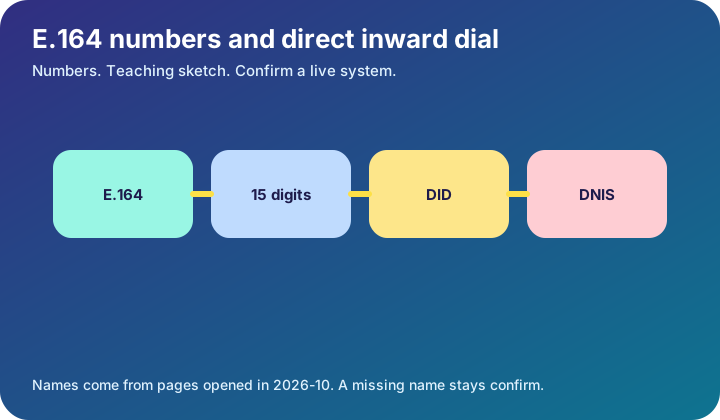
Count the boxes: 4. Each label is a name from a page or a study label marked on the drawing.
Flow
What is going on
Fifteen digits is the maximum the E.164 article states. It is not a promise that every platform stores fifteen digits, and it is not a price. The ITU page's in-force label is E.164 (02/26). A vendor's number-ordering screen was not that recommendation.
DID is the PBX feature that lets an outside caller reach an extension. DNIS is how the article says the dialed number is presented, often shortened. A CPaaS phone number can play a similar role. The article's mechanism is still the PBX and the trunk.
Worked example
Write + and then only digits, and stop at fifteen if you are checking the E.164 maximum. Then write the extension and the DNIS digits the PBX actually receives. If a portal shows a different maximum, cite the portal. This room cites the article and the ITU page.
Quiz
1. The E.164 article limits plan-conforming numbers to fifteen digits.
True. That maximum is in the introduction that opened.
2. DID means the PBX never learns which number was dialed.
False. The article says the dialed number is transmitted so the extension can be reached.
Ecosystem
Sister pieces sit on the ecosystem page: the glossary, the mind map, the integration map, and the bridges.
- E.164 — The ITU-T international public telecommunication numbering plan. The Wikipedia summary says conforming numbers are digits only, at most fifteen.
- DID — Direct inward dialing. The article also says DDI is the name used in Europe and Oceania.
Config. Store the full E.164 form and the DNIS slice as two fields. Do not assume they are equal.
Troubleshooting. If the attendant answers every DID, the PBX is not using the dialed number the article describes. Check DNIS before you buy another trunk.
Bridge. RFC 3966 is the tel URI for a telephone number in SIP. E.164 is the numbering plan. They meet when you put a number into a URI.
Mind map, sister technologies, and future hooks live on the ecosystem page.
Sources and go deeper
Opened 2026-10. A row marked confirm has no link, because that page was not verified.
- Wikipedia. E.164 last checked 2026-10
- ITU. ITU-T E.164, the international public telecommunication numbering plan last checked 2026-10
- Wikipedia. Direct inward dial last checked 2026-10
- RFC. RFC 3966, the tel URI last checked 2026-10
- Confirm. A country's current numbering-plan exception. confirm. Not opened beyond the general E.164 text. last checked 2026-10