T5 · T5-R13 · STIR and SHAKEN
A, B, and C on the STIR article
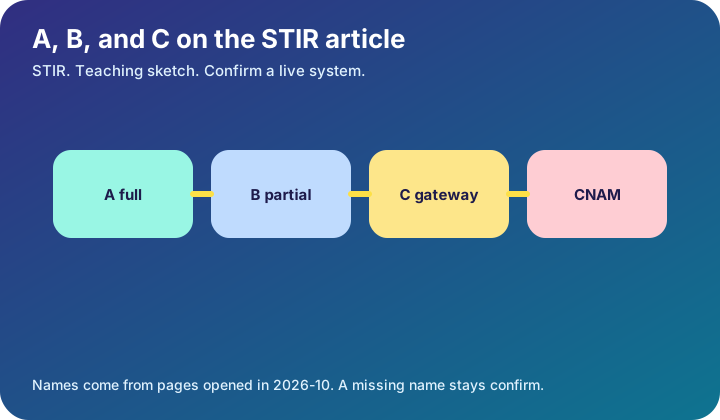
The letters are the part you can teach without a vendor portal. A is the whole number. B is a known customer and an unverified extension. C is only a known gateway. The article's PBX example is why a CPaaS trunk and a customer's own extension list are different attestation problems.
Counts on this page
Opened sources
Confirm rows, no URL
Learn it in 5 minutes
- Wikipedia says STIR/SHAKEN is a suite of protocols and procedures intended to combat caller ID spoofing.
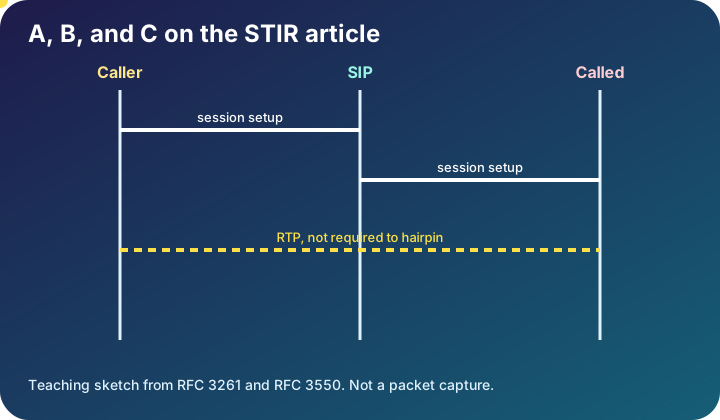
- It says STIR is Secure Telephone Identity Revisited, defined in IETF RFCs, and that it adds a digital certificate to the SIP information used to route VoIP calls.
- The article says there are three attestation levels. A, Full Attestation, means the provider recognizes the entire phone number as registered to the originating subscriber.
- B, Partial Attestation, means the call came from a known customer but the entire number cannot be verified, as with a PBX extension the provider has not registered.
- C, Gateway Attestation, means the call can only be verified as coming from a known gateway, for example a connection from another provider.
Visual
Count the boxes: 4. Each label is a name from a page or a study label marked on the drawing.
Flow
What is going on
The letters are the part you can teach without a vendor portal. A is the whole number. B is a known customer and an unverified extension. C is only a known gateway. The article's PBX example is why a CPaaS trunk and a customer's own extension list are different attestation problems.
Caller ID, on its own article, is the service that transmits the calling number during call setup, and it may include a name, CNAM. The service was first defined in ITU-T Q.731.3 in 1993, that article says. Spoofing is what STIR/SHAKEN is for. Displaying a number is the older service.
Worked example
Three calls. A desk phone whose number the provider registered: write A. A PBX extension the provider has never seen: write B, using the article's example. A call that only proves which carrier handed it over: write C.
Quiz
1. Partial Attestation, B, is the article's label when the customer is known and the full number is not verified.
True. The PBX-extension example is in that paragraph.
2. Gateway Attestation means the provider recognizes every digit of the caller's number.
False. C means the call is verified only as coming from a known gateway.
Ecosystem
Sister pieces sit on the ecosystem page: the glossary, the mind map, the integration map, and the bridges.
- Full Attestation — The STIR article's A level: the provider recognizes the entire calling number as the subscriber's.
- CNAM — Calling Name Presentation, the name service the Caller ID article describes alongside the number.
Config. Store the attestation letter next to the call if the platform shows one. Do not invent the letter from the caller ID text.
Troubleshooting. A legitimate PBX extension marked B matches the article. Fixing it means registering the number, not turning STIR off.
Bridge. RFC 8224 is the SIP identity mechanism this lab opened next. The letters A, B, and C were read on Wikipedia, not copied from that RFC's title.
Mind map, sister technologies, and future hooks live on the ecosystem page.
Sources and go deeper
Opened 2026-10. A row marked confirm has no link, because that page was not verified.
- Wikipedia. STIR/SHAKEN last checked 2026-10
- Wikipedia. Caller ID last checked 2026-10
- RFC. RFC 8224, authenticated identity management in SIP last checked 2026-10
- Confirm. A country's legal penalty for a failed attestation. confirm. Enforcement pages were not opened as statutes. last checked 2026-10