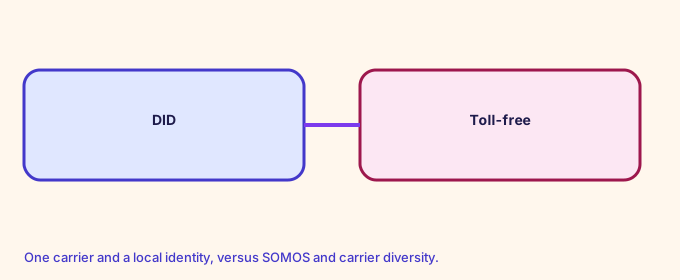
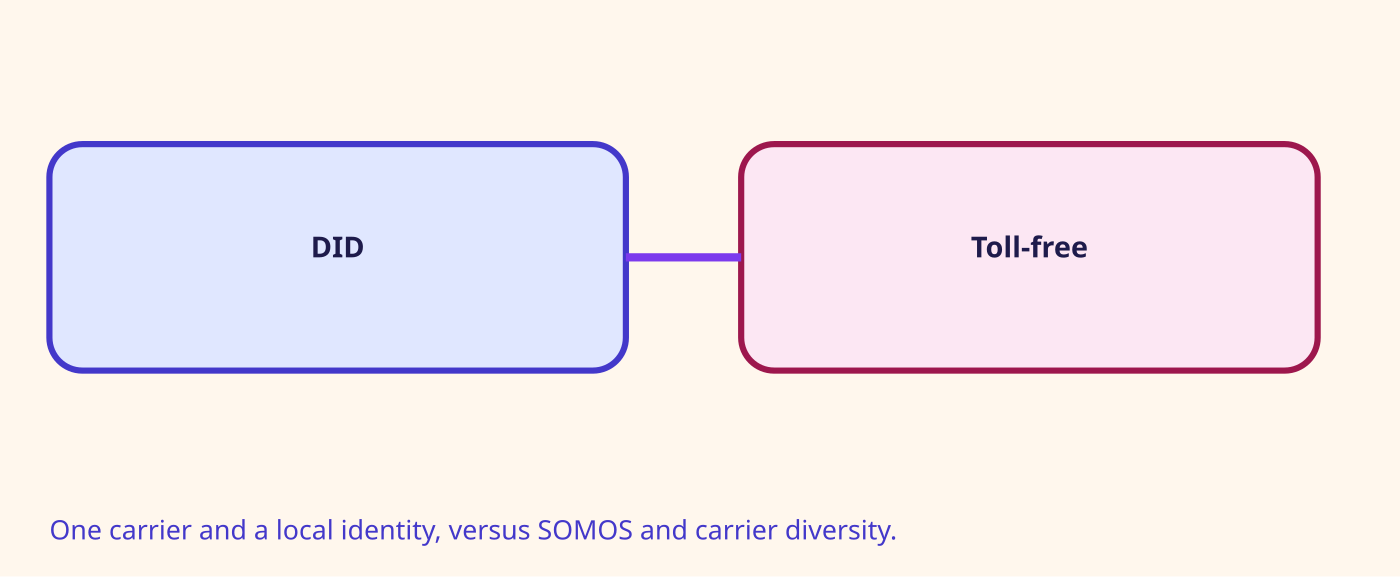
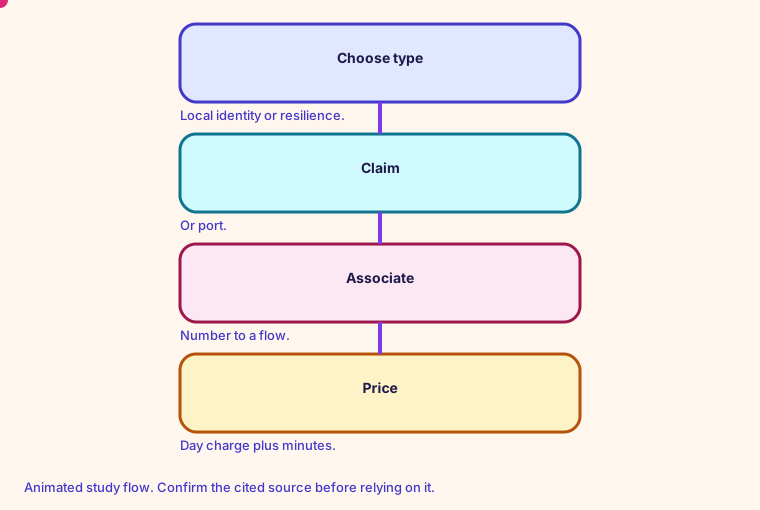
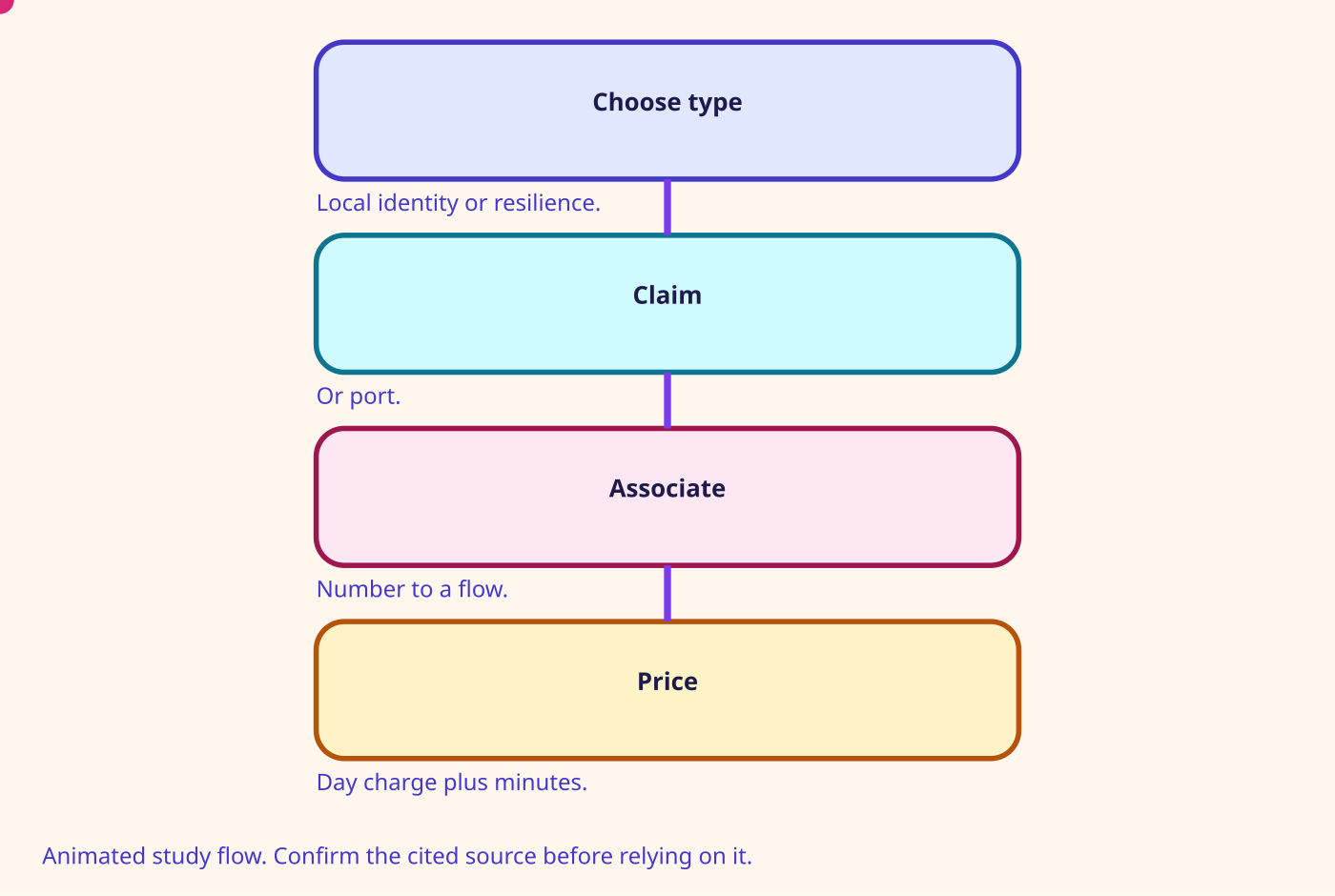
The number type is a cost and a failure-domain choice.
Connect sells four types, in more than 100 countries, billed per day plus per-minute telephony. A US DID in the Oregon worked example is 0.030 USD per day, 0.0022 USD per inbound minute, and outbound US telephony at 0.0048 USD per minute.
US toll-free numbers are registered with SOMOS. AWS can place them on more than one carrier, which is why they cost more and why they are the more resilient public number. The appendix example charges 0 USD per day for the first 12 months of the free tier and 0.06 USD per day after. Country rates that are not in that example must be read from the global telephony table, not invented.
DID is one carrier. It presents a local number. It is not load-balanced across carriers.
You can mix DID and toll-free on one instance.
Inbound telephony in the example is charged per minute with a 60 second minimum.
Voice service is a second charge, 0.038 or 0.018 USD per minute depending on the product form, billed per second with a 10 second minimum.
Number on this page: US DID day $0.030. Oregon example, 14 Oct 2026 card
Confirm before relying. Prices, quotas, and exam names change. Use the source linked on this page.
Which term matches this description? Universal International Freephone number. One of the four number types Connect sells, with DID, toll-free, and shared cost.
Show the cited answer
Universal International Freephone number. One of the four number types Connect sells, with DID, toll-free, and shared cost. The term is UIFN.
Which term matches this description? A number the caller does not pay long-distance to dial. US toll-free numbers are registered with SOMOS and can use more than one carrier.
Show the cited answer
A number the caller does not pay long-distance to dial. US toll-free numbers are registered with SOMOS and can use more than one carrier. The term is Toll-free number.
DID A direct inward dial number. In the US it is carried by one carrier and priced per day plus per minute.
Toll-free number A number the caller does not pay long-distance to dial. US toll-free numbers are registered with SOMOS and can use more than one carrier.
UIFN Universal International Freephone number. One of the four number types Connect sells, with DID, toll-free, and shared cost.
Porting Moving a number from another carrier onto Connect. The quota page points you at the same Support form used for quota increases.
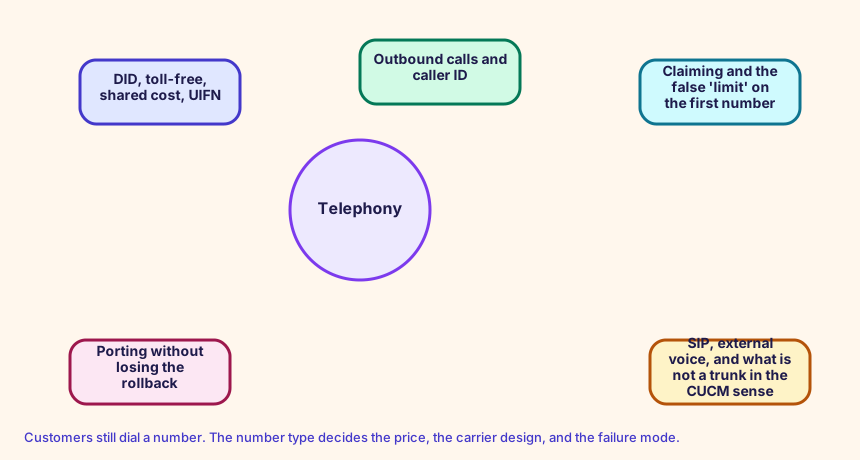
Customers still dial a number. The number type decides the price, the carrier design, and the failure mode.
Config and troubleshooting
Quoting a toll-free per-minute rate you did not look up.
AWS::Connect::PhoneNumber claims a DID or toll-free number into the instance. The first claim can still fail a service quota even when the template is valid.
Resources:
  PilotDid:
    Type: AWS::Connect::PhoneNumber
    Properties:
      TargetArn: !GetAtt CampusInstance.Arn
      CountryCode: US
      Type: DID
      Prefix: "+1503"
Integration map
Join records on ContactId. The integration map room lists the seams.
Cross-platform bridges
A CUCM calling search space is not a routing profile, but the profile is the closest idea of 'who can receive what'. A partition is not a Connect object. A UCCX CSQ and a UCCE skill group map to a queue. Precision steps map to routing criteria. A script, an Architect flow, and an Avaya vector map to a contact flow.
Hooks you can adopt later: EventBridge contact events, the CTR stream, agent events, Kinesis Video, Customer Profiles events, Cases, Show view, data tables, External Tool, and the flow language JSON in your pipeline. Live Sync and Agentic CX are the 2026 hooks for guided and agentic experiences.