A contact-center platform is not automatically an emergency-calling design. In the US Regions where this exists, you still have to store a real address.
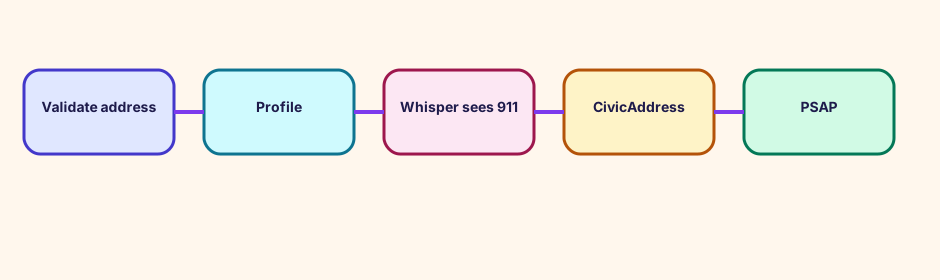
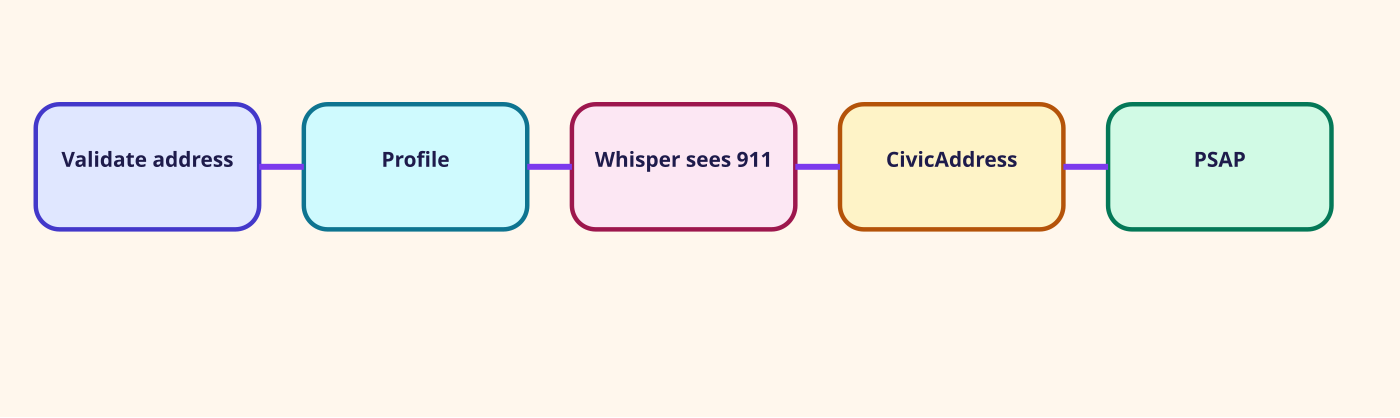
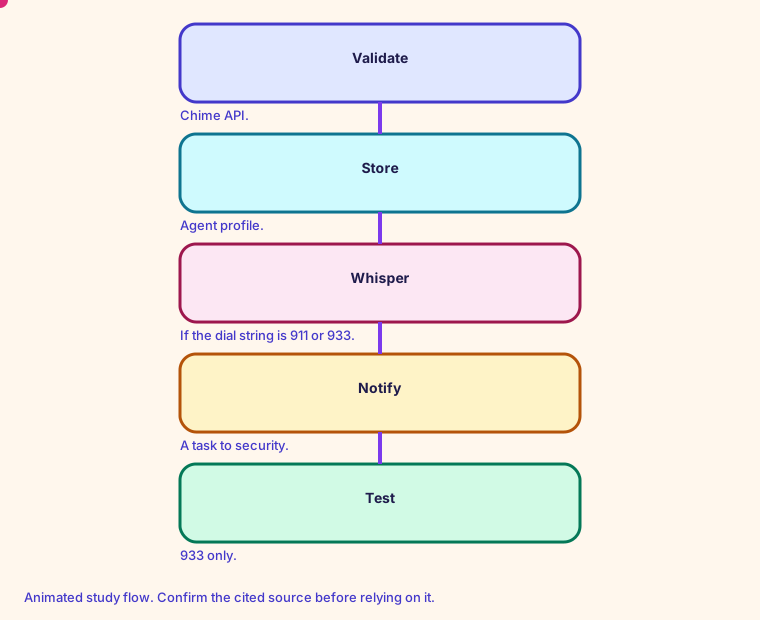
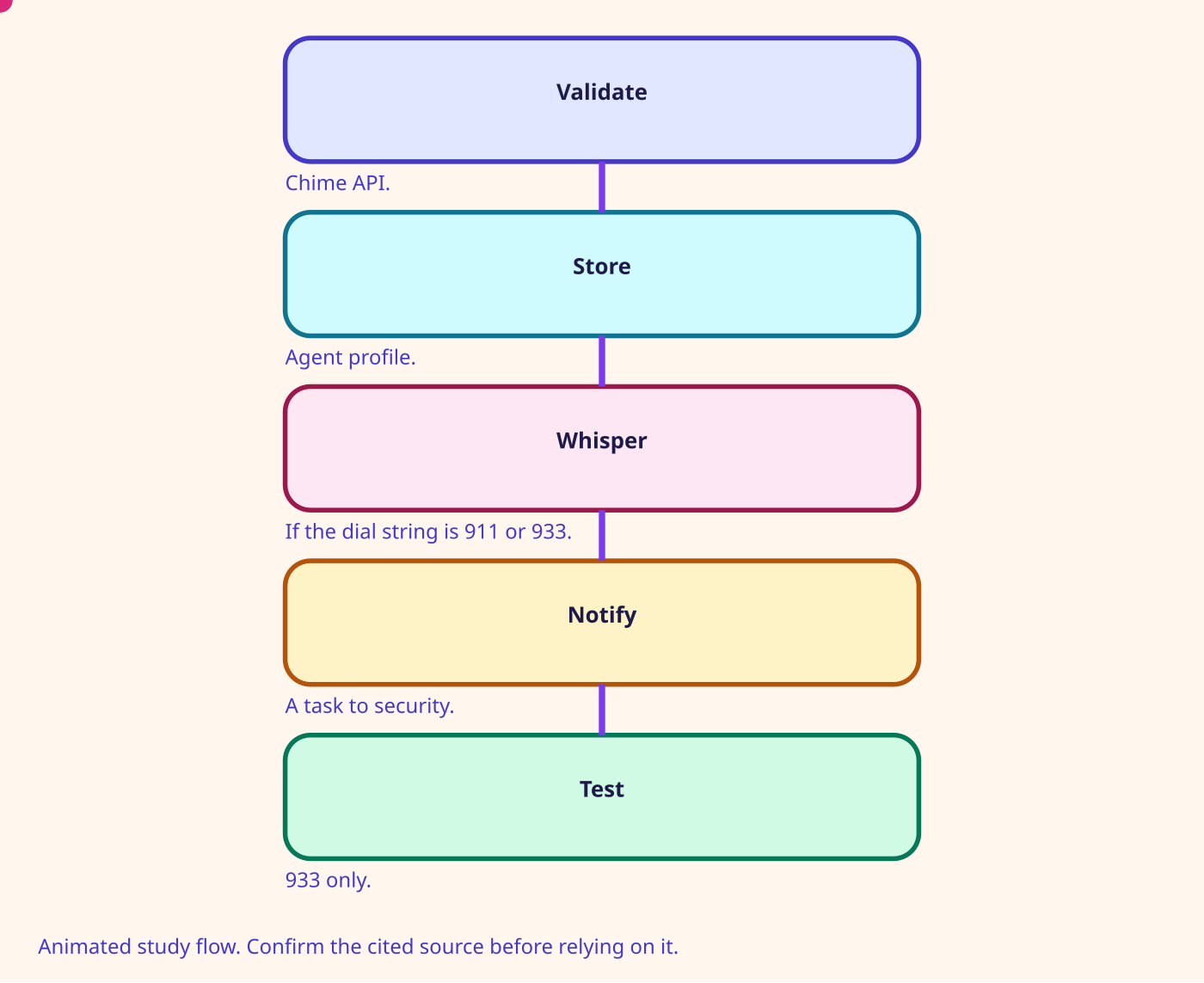
Direct 911 from the CCP is enabled by default in US East (N. Virginia), US West (Oregon), and GovCloud US-West. Connect does not transfer a live call to 911 and does not let an agent dial 911 while already on a call. E911 sends a validated physical address. You validate with the Chime ValidateE911Address API, store it on the agent's Customer Profile, and an outbound whisper flow copies it to the CivicAddress attribute when the dialed string is 911.
Test with 933. It reads back the number and the address. The docs describe a 100 USD penalty for a non-emergency 911 call. The origination number must be callable if responders need to ring back. Create a task in that whisper flow so security is notified. Home agents must update the address when they move. A CUCM ELIN for the office does not cover them.
CivicAddress is a JSON string, not a JSON object. The keys include country, A1, A3, HNO, RD, STS, and PC.
Prompt agents to confirm the address at the start of a shift if they roam.
This is not available as a transfer from a customer call.
Outside those Regions, do not invent a 911 design. Use the local emergency method and say so.
Number on this page: Test 933. Not a live 911 test
Confirm before relying. Prices, quotas, and exam names change. Use the source linked on this page.
Which term matches this description? The test number that reads back the originating number and the address. Use it instead of a real 911 test. A non-emergency 911 call is described as a 100 USD penalty.
Show the cited answer
The test number that reads back the originating number and the address. Use it instead of a real 911 test. A non-emergency 911 call is described as a 100 USD penalty. The term is 933.
Which term matches this description? The contact attribute that carries the E911 address as a JSON string. Keys include country, A1, A3, HNO, RD, STS, and PC.
Show the cited answer
The contact attribute that carries the E911 address as a JSON string. Keys include country, A1, A3, HNO, RD, STS, and PC. The term is CivicAddress.
Start media streaming Sends live customer audio to Kinesis Video Streams for a third-party recorder or bot.
Screen recording Records the agent desktop. On the Basic price list it is 0.006 USD per minute.
Forecasting and agent scheduling The 4 Aug 2026 name for native WFM: forecast, capacity, schedules, and adherence.
Schedule adherence How closely an agent's actual status matched the published schedule. Native metrics appear after schedules are published. Third-party WFM reads agent events.
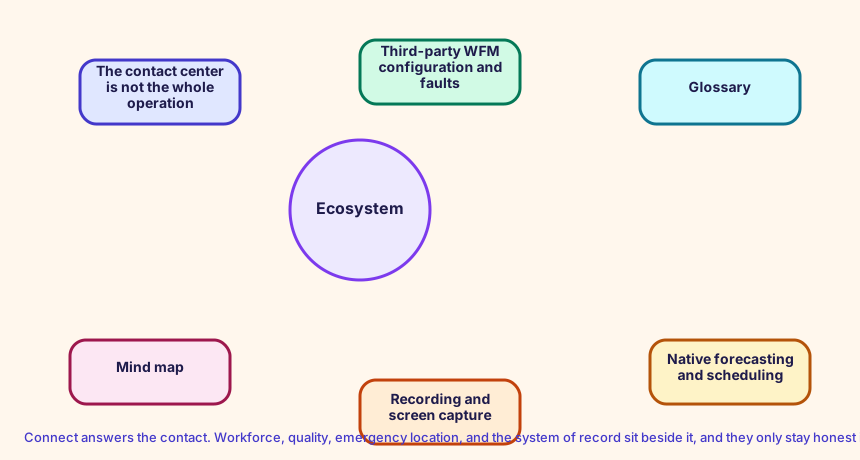
Connect answers the contact. Workforce, quality, emergency location, and the system of record sit beside it, and they only stay honest if they share ContactId.
Config and troubleshooting
Telling home agents to dial 911 on the CCP while the stored address is the headquarters.
Adherence needs agent events, not a person refreshing a report. ResourceType AGENT_EVENTS and StorageType KINESIS_STREAM is the hook. A second consumer should read the stream, not a second delivery on the instance.
Join records on ContactId. The integration map room lists the seams.
Cross-platform bridges
A CUCM calling search space is not a routing profile, but the profile is the closest idea of 'who can receive what'. A partition is not a Connect object. A UCCX CSQ and a UCCE skill group map to a queue. Precision steps map to routing criteria. A script, an Architect flow, and an Avaya vector map to a contact flow.
Hooks you can adopt later: EventBridge contact events, the CTR stream, agent events, Kinesis Video, Customer Profiles events, Cases, Show view, data tables, External Tool, and the flow language JSON in your pipeline. Live Sync and Agentic CX are the 2026 hooks for guided and agentic experiences.