Learn it in 5 minutes
HTMLAbout five minutes of reading
A hiring plan and a scheduling plan do not read the same forecasts.
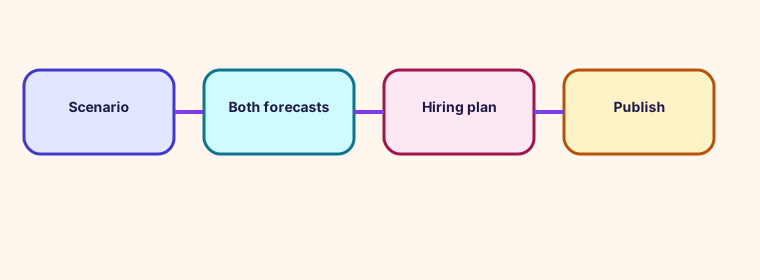
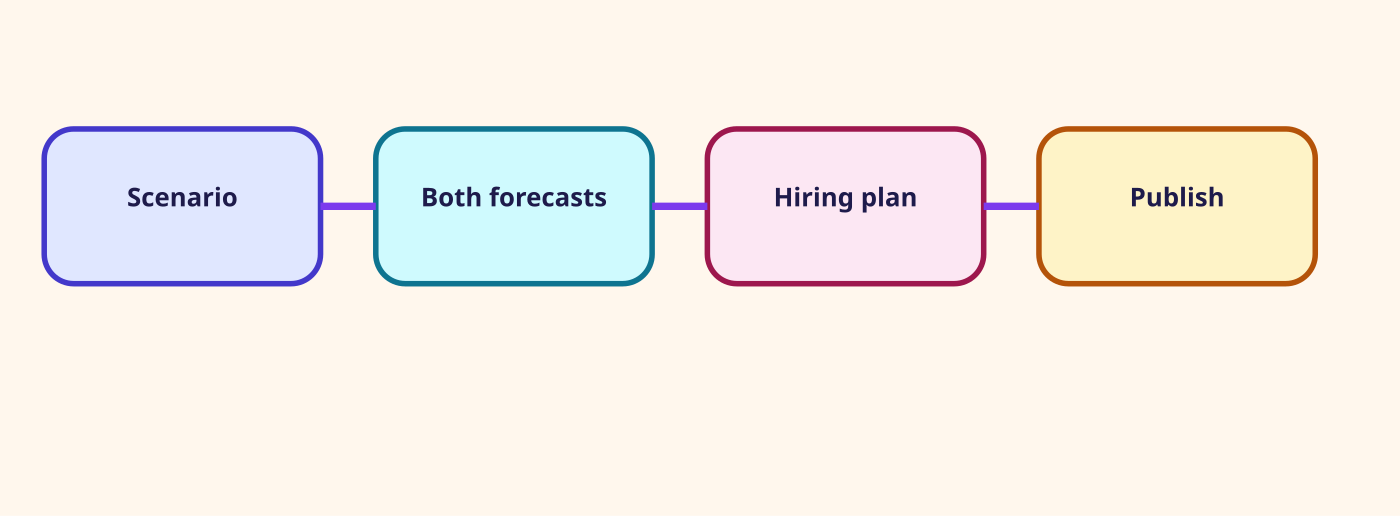
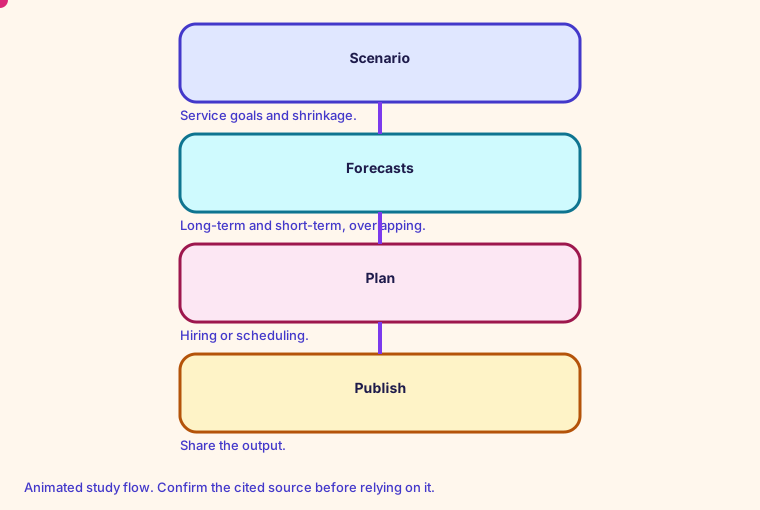
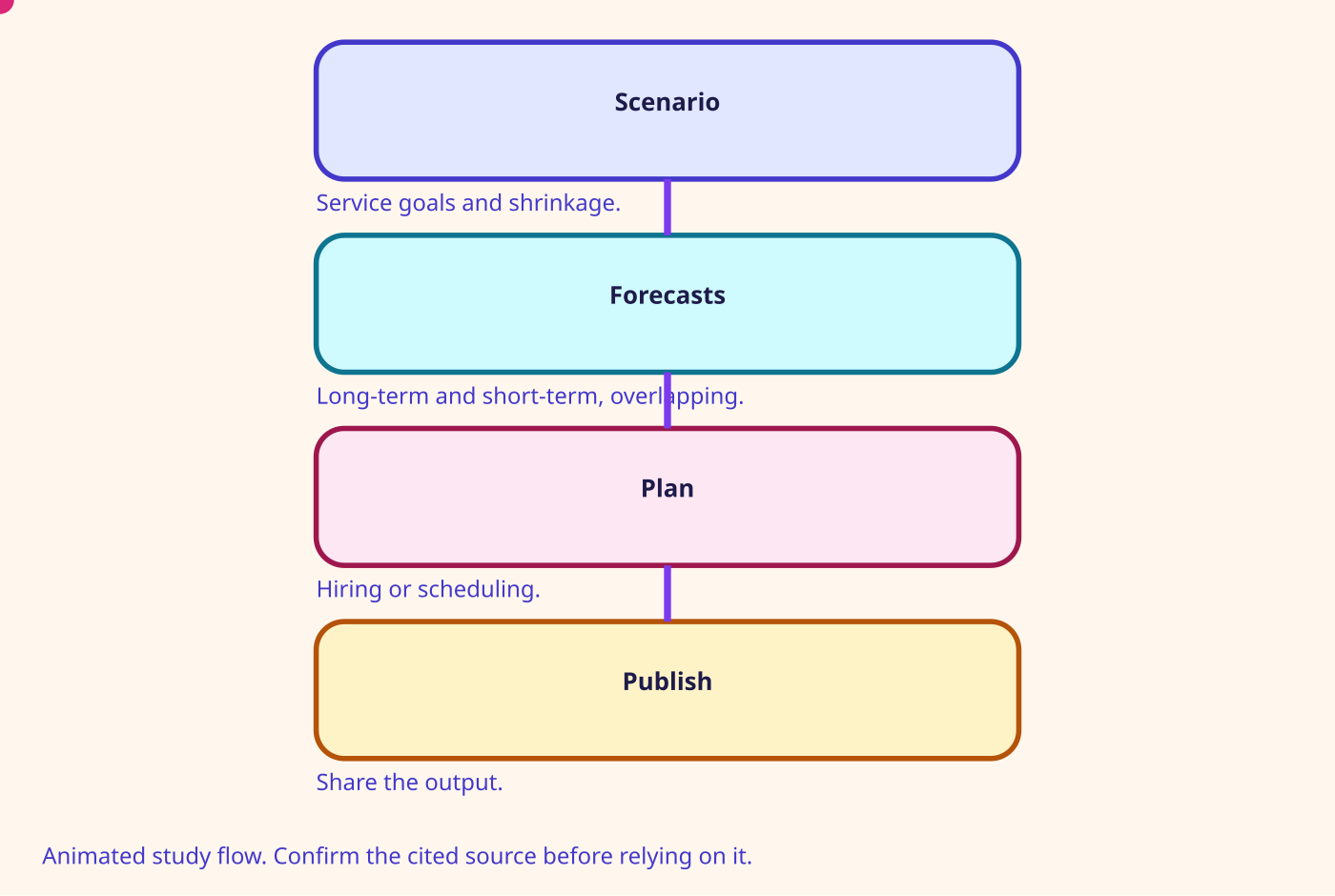
A capacity plan turns forecasts and a scenario into staffing targets. A Hiring plan estimates long-term full-time equivalents, up to 64 weeks, and needs both a long-term and a short-term forecast. The capacity page recommends at least 4 weeks of overlap and requires at least 1 day.
A Scheduling plan needs only a published short-term forecast. It returns headcount in 15- or 30-minute intervals, matching that forecast, and the plan dates must sit inside the forecast dates. Plan override is not available for a Scheduling plan.
- Create a scenario before you create the plan.
- Shrinkage and available full-time equivalents can be imported. Hiring plans use day-level files. Scheduling plans use interval-level files.
- Task and email plans can start from an automatic backlog when you use an average time to complete.
- The getting-started list ends with review, then publish. Override and re-run are for hiring plans.
Number on this page: Hiring 64 weeks. Long-term full-time equivalent estimates
Glossary
- Start media streaming Sends live customer audio to Kinesis Video Streams for a third-party recorder or bot.
- Screen recording Records the agent desktop. On the Basic price list it is 0.006 USD per minute.
- Forecasting and agent scheduling The 4 Aug 2026 name for native WFM: forecast, capacity, schedules, and adherence.
- Schedule adherence How closely an agent's actual status matched the published schedule. Native metrics appear after schedules are published. Third-party WFM reads agent events.
Mind map
Open the Ecosystem mind map
Sister technologies
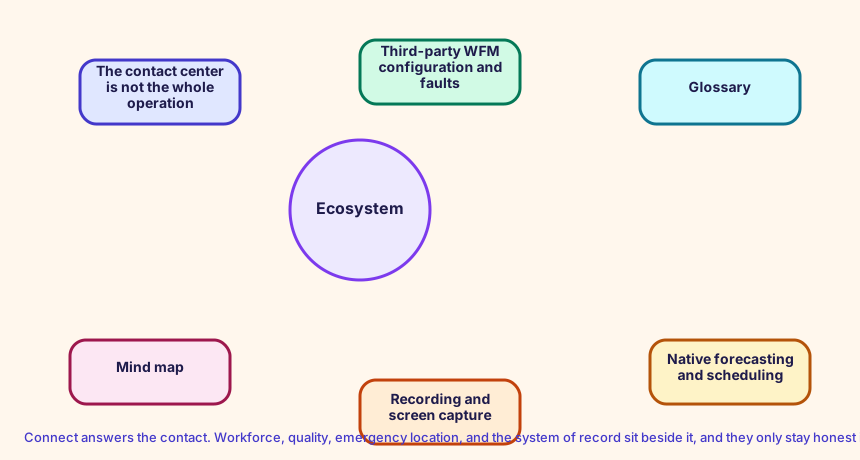
Connect answers the contact. Workforce, quality, emergency location, and the system of record sit beside it, and they only stay honest if they share ContactId.
Config and troubleshooting
Building a hiring plan from a short-term forecast alone.
Adherence needs agent events, not a person refreshing a report. ResourceType AGENT_EVENTS and StorageType KINESIS_STREAM is the hook. A second consumer should read the stream, not a second delivery on the instance.
InstanceStorageConfig
CloudFormation study snippet
Resources:
  AgentEvents:
    Type: AWS::Connect::InstanceStorageConfig
    Properties:
      InstanceArn: !GetAtt CampusInstance.Arn
      ResourceType: AGENT_EVENTS
      StorageType: KINESIS_STREAM
      KinesisStreamConfig:
        StreamArn: !GetAtt AgentStream.Arn
Integration map
Join records on ContactId. The integration map room lists the seams.
Cross-platform bridges
A CUCM calling search space is not a routing profile, but the profile is the closest idea of 'who can receive what'. A partition is not a Connect object. A UCCX CSQ and a UCCE skill group map to a queue. Precision steps map to routing criteria. A script, an Architect flow, and an Avaya vector map to a contact flow.
Open the mapping room
Future hooks
Hooks you can adopt later: EventBridge contact events, the CTR stream, agent events, Kinesis Video, Customer Profiles events, Cases, Show view, data tables, External Tool, and the flow language JSON in your pipeline. Live Sync and Agentic CX are the 2026 hooks for guided and agentic experiences.