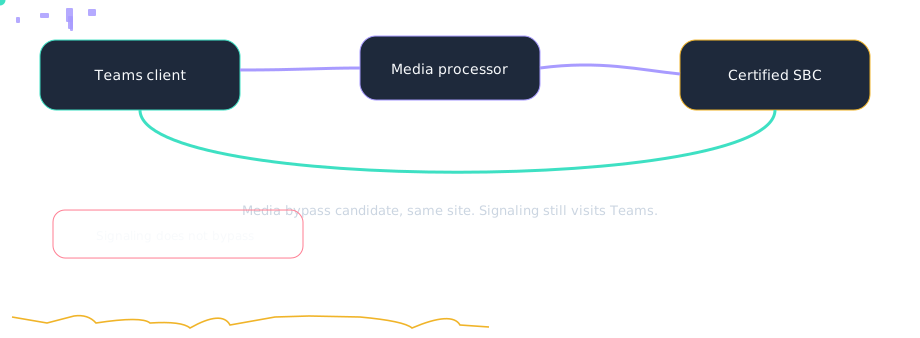
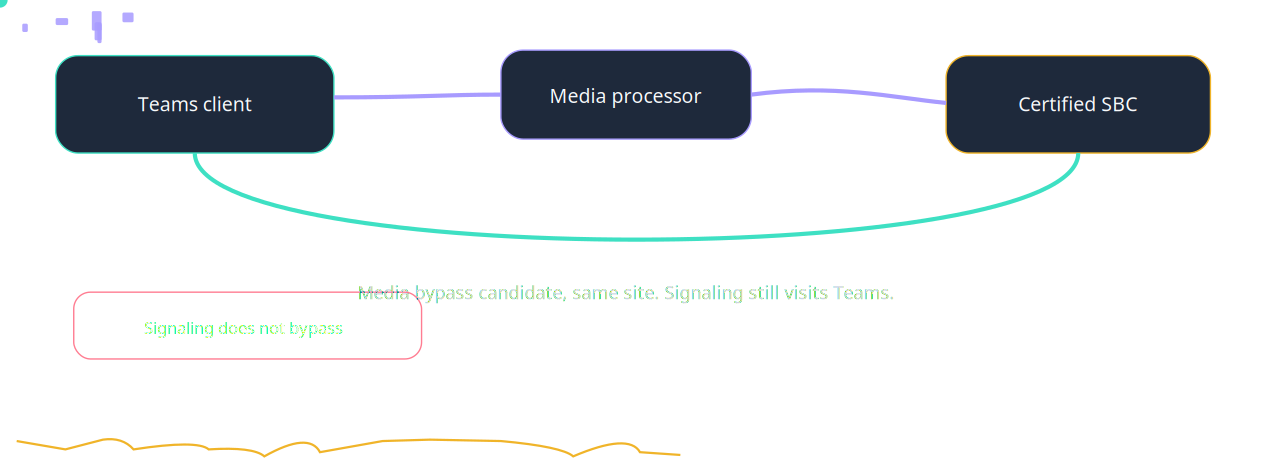
With media bypass enabled on the gateway, media can run directly between the Teams client and the SBC instead of through Microsoft’s media processors.Signaling still uses the PSTN hubs.Microsoft does not support re-targeting that media mid-call.
Bypass is a candidate when the user is on a network that can reach the SBC.A full-tunnel VPN is a poor candidate.Location-based routing may forbid the path.AMR-WB is listed for non-bypass only.If bypass is off, open UDP 3478–3481 and 49152–53247.
Media bypass skips the media processor, not the SIP proxy.Turn it on only when the client can reach the SBC.
Two paths for Media bypass. RTP may skip the processor. SIP does not.Signaling does not bypass. Counts in this drawing are teaching order, not customers.
A colleague reports: A bargain SIP phone is forced through SIP Gateway and the feature list is wrong. Where do you start?
A bargain SIP phone is forced through SIP Gateway and the feature list is wrong. Buy from the current certified list and assign Teams Phone plus a number. Source: https://learn.microsoft.com/en-us/microsoftteams/sip-gateway-plan accessed 2026-10-14.
Which description of Analog via Direct Routing is accurate?
Fax, door phones, and elevators usually stay on an SBC or SIP Gateway, not on a Teams client. A Calling Plan user license does not give you an elevator phone. Source: https://learn.microsoft.com/en-us/microsoftteams/sip-gateway-plan accessed 2026-10-14.
A colleague reports: The elevator is moved to Teams as a user and cannot dial during a WAN cut. Where do you start?
The elevator is moved to Teams as a user and cannot dial during a WAN cut. Put analog on the SBC design and test the emergency path from that device. Source: https://learn.microsoft.com/en-us/microsoftteams/sip-gateway-plan accessed 2026-10-14.
Teams Rooms license Rooms use their own SKU family, not a borrowed user Calling Plan. Names such as Basic and Pro change. Check the current name. Config: Assign the current room license to the room account and keep Conditional Access from blocking the device. Fault: The room account has a user E5 stack and still fails sign-in policy.
Media bypass Media can flow between the Teams client and the SBC, skipping Microsoft’s media processors. Signaling still goes through Teams. Config: Enable it on the gateway only when the client can reach the SBC and LBR does not forbid the path. Fault: Bypass is on for a VPN user and audio is worse than the processor path.
Local media optimization A Direct Routing pattern with internal and external SBC interfaces so a branch user stays on the local media path. Config: Use the current media optimization article and the SBC vendor’s build. Fault: Internal users hairpin out to the internet and back to the SBC on the same LAN.
SIP Gateway Microsoft’s front end for certain compatible analog and SIP devices that are not Teams phones. Config: Check the current supported device list before you buy handsets. Fault: A generic analog adapter is plugged in and never registers.
Sister technologies
Around the call: compliance recording, workforce management, emergency location, analytics, CRM screen pop, and an agent with a human escape. Each one has its own failure.
Config and troubleshooting
Bypass is enabled for VPN users and audio gets worse.
Cross-platform bridges
CUCM
Cisco CUBE is one of the SBC families named in this lab’s certification lesson. A certified release can be the Direct Routing SBC between Unified CM and Teams.
The tenant still needs a verified domain on the SBC FQDN, and the user still needs Teams Phone. The studio translator does not open a live AXL session. Confirm the current certified release before you build.
Webex
Teams Phone and Webex Calling are separate clouds. This lab does not describe a feature that registers a Webex Calling user into a Teams tenant.
A number move is usually a carrier port, a certified SBC, or a meetings interop product. Confirm before relying.
UCCE
Unified CCE stays the ACD until you migrate it. Microsoft’s contact-center articles name Connect, Extend, and Unify. They do not name a UCCE connector in the notes this lab cites.
Session Initiation Protocol — Wikipedia — last checked 2026-10. Wikipedia fallback for background. Confirm the vendor page before you change a tenant
Microsoft Teams blog index — Community — last checked 2026-10. Community index for the Microsoft Teams blog. This is the index, not a claim that a post discusses this room