Dhātu and pada basics
Names for verb roots and word classes, and the list this app does not have.
Learn it in 5 minutes
Learner's note (not a translation): dhātu is the classroom name for a verb root, and a pada is a finished word. People also meet tiṅ (verb endings) and sup (nominal endings) as names of ending sets. This page does not quote a sūtra that defines them, because that would be a translation.
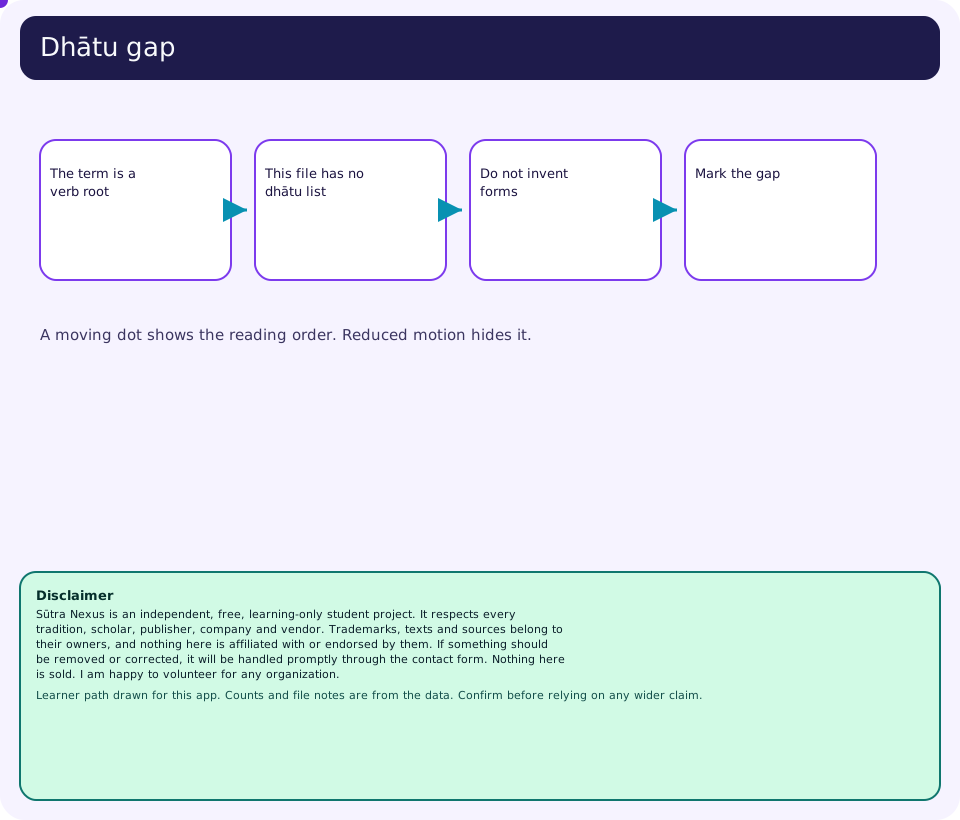
The Aṣṭādhyāyī data file has no dhātu inventory. The repository README of ashtadhyayi-com/data, opened 2026-10-16, mentions dhātu forms as data the website edits, but those forms are not in the three JSON files shipped here.
So this room teaches the gap. You can learn the words as labels. You cannot look up a root's forms in this app yet.
Confirm before relying on any root list you remember from a class until it is tied to an opened edition.
Foundations, dependencies, history, roadmap
Dependencies. Aṣṭādhyāyī structure.
History. No century is assigned to the root lists.
Roadmap. If an open dhātu file is confirmed, add it as its own dataset with the licence recorded.
Where the idea shows up. Morphological analyzers store roots and endings. Pointing at a specific analyzer needs a citation this page does not have. Confirm before relying.
A visual
SVG · PNG · Standalone HTML
Worked example
Notice the missing list
- Search this site's downloads for a dhātu table. There isn't one.
- The three JSON files are the sūtra rows, the 14 lines, and the 75 Kashmir lines.
- A worksheet in the downloads asks you to record a root only when you have a source in hand.
- Leave the meaning column as not yet sourced.
Quiz
Does this app ship a dhātu inventory?
What is a learner's note allowed to say a dhātu is?
Where would a future root list have to come from?
What endings are named, without a quotation?
Which file would you open for the 14 lines?
Ecosystem
Glossary
- dhātu — Classroom name for a verb root. No inventory in this app. Confirm before relying.
- pada — Classroom name for a finished word.
- tiṅ — Classroom name for a set of verb endings. Not quoted from a sūtra here.
- sup — Classroom name for a set of nominal endings. Not quoted from a sūtra here.
Sister topics
Anuvṛtti and play.
Bridges
Learner's note (not a translation): a root plus an ending is a familiar shape in computing. The shape is an analogy until a text is cited.
Later hooks
A worksheet that refuses a blank source line.
Sources and go deeper
- ashtadhyayi-com/data README. The raw README says you are free to use the data in your own projects if you give appropriate credit. No SPDX identifier is stated. last checked 2026-10. Licence: credit required, no formal SPDX, confirmed from the raw README.