Sandhi basics
Sound-joining as an idea, without an invented example join.
Learn it in 5 minutes
English Wikipedia's Sandhi page, checked 2026-10-16, uses the short description "type of sound change at morpheme or syllable boundaries." This app uses that as the plain name of the topic.
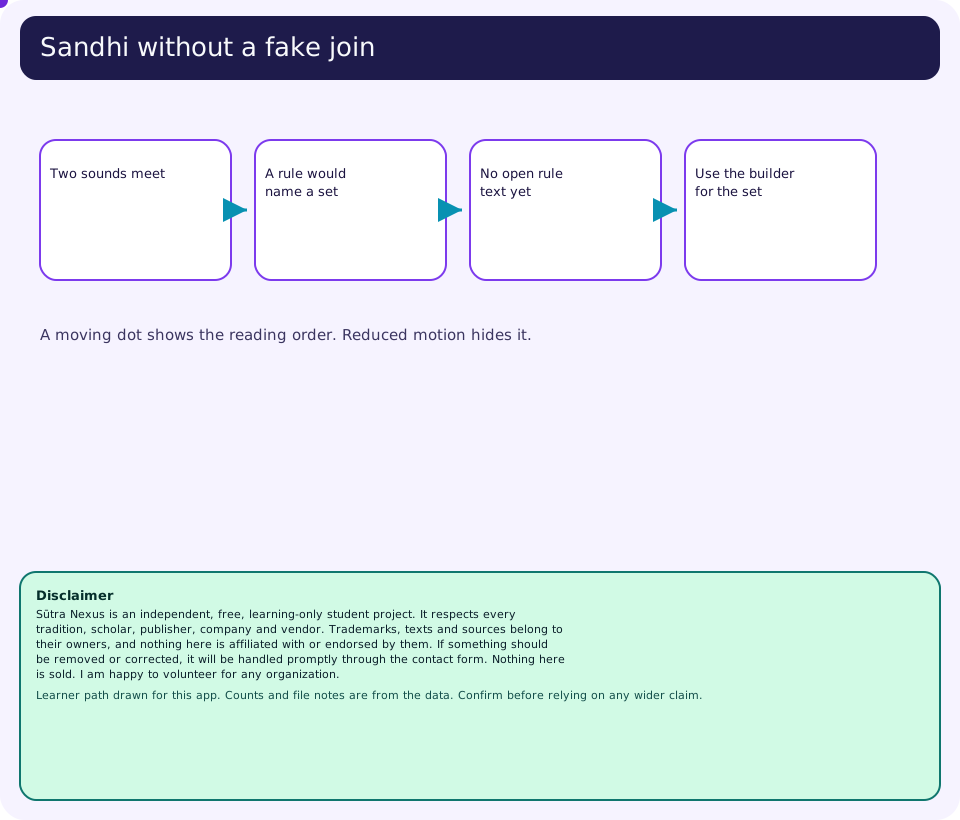
A sandhi rule in the Aṣṭādhyāyī tradition is often taught as naming a set of sounds with a pratyāhāra, then stating what happens when those sounds meet. This app can show the set, because the set is computed from the 14 lines. It cannot show the operation of a particular rule, because the English of that rule is not yet sourced from an open text.
There is no sample join such as a textbook word pair on this page. Adding one would be writing a result this project has not cited.
Learner's note (not a translation): when you are ready to study a real rule, open a sourced edition, find the pratyāhāra it names, and check that set in the builder. Confirm before relying.
Foundations, dependencies, history, roadmap
Dependencies. Māheśvara lines, because the sets come from them.
History. This page does not date the rules.
Roadmap. Quote one open-licensed sandhi rule, then show only what that quotation says.
Where the idea shows up. Tokenizer and phonology textbooks also talk about boundary changes. A mapping needs its own citation. Confirm before relying.
A visual
SVG · PNG · Standalone HTML
Worked example
Use the set, stop before the join
- Suppose a classroom says a rule applies inside ac.
- Compute ac. The sounds are a i u ṛ ḷ e o ai au.
- Stop. The app does not apply a change to an example word.
- The meaning of the rule that would name ac is not yet sourced from an open text.
Quiz
What does the Sandhi Wikipedia short description say?
Why is there no example word join?
What can you compute today?
What label covers a plain-English hint on this page?
Where do you go to recompute ac?
Ecosystem
Glossary
- sandhi — Sound change where pieces meet, per the Wikipedia short description cited here.
- set — The sounds a pratyāhāra names in this app's computation.
Sister topics
Māheśvara and anuvṛtti.
Bridges
Learner's note (not a translation): a boundary rule is easier to see once the set has a name. The name here is the pratyāhāra.
Later hooks
One cited rule, with the edition's page.
Sources and go deeper
- English Wikipedia, Sandhi. Short description on the page: a type of sound change at morpheme or syllable boundaries. last checked 2026-10. Licence: CC BY-SA 4.0.
- ashtadhyayi-com/data README. The raw README says you are free to use the data in your own projects if you give appropriate credit. No SPDX identifier is stated. last checked 2026-10. Licence: credit required, no formal SPDX, confirmed from the raw README.