Foundations
Devanāgarī, IAST, and the phonetic chart this app will not invent.
Learn it in 5 minutes
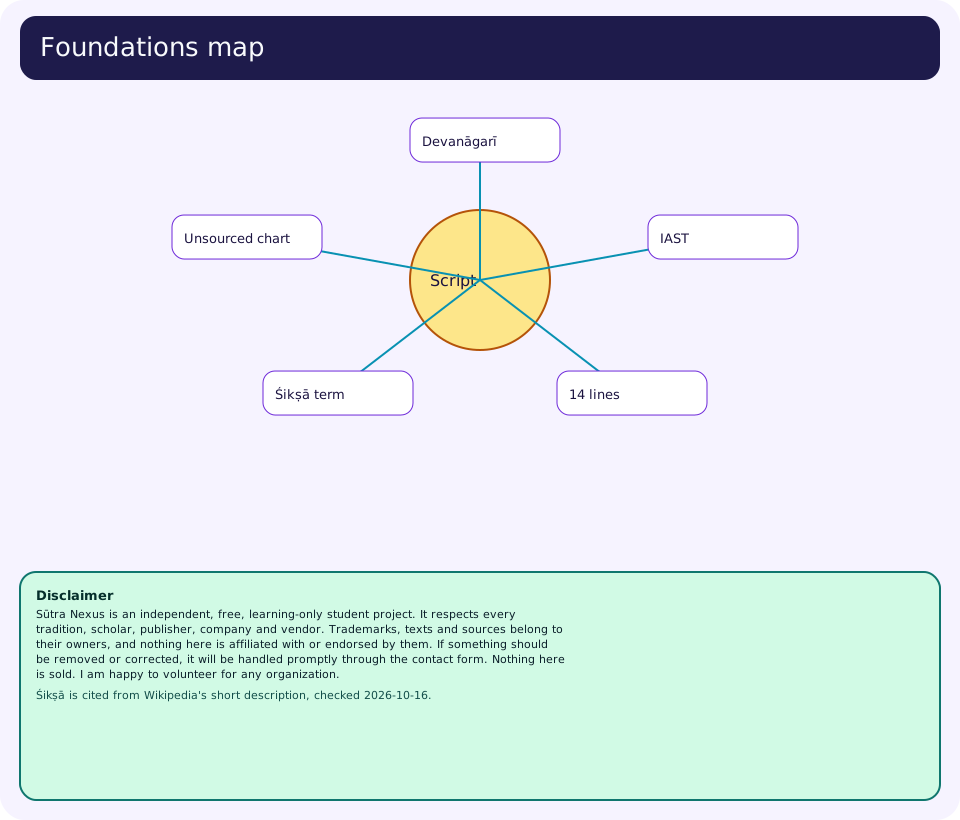
The rows in this app are written in Devanāgarī. English Wikipedia's Devanagari page, checked 2026-10-16, describes it in the short description as an Indic script used in the Indian subcontinent.
IAST is the Latin scheme used beside those rows. English Wikipedia's IAST page, checked the same day, calls it a transliteration scheme for Indic scripts. In the Aṣṭādhyāyī file the IAST was produced by a script and has not been checked by a person. The label is: script-converted, not yet human-checked.
English Wikipedia's Shiksha page, checked 2026-10-16, calls Śikṣā a Vedic-era study of phonetics and phonology, one of six Vedangas. Sthāna (place) and prayatna (effort) are the classroom names for phonetic charts. This app does not draw those charts, because no open phonetic edition was opened and recorded. Confirm before relying on any place-of-articulation table you bring from elsewhere.
What you can trust here is the 14-line sound list in the data file, printed as the file records it.
Foundations, dependencies, history, roadmap
Dependencies. Start here.
History. The Śikṣā page calls the study Vedic-era. This app does not assign a year.
Roadmap. An opened phonetic source, then a chart with that citation.
Where the idea shows up. Speech technology uses place and manner features. Mapping those features onto this tradition needs a cited source. Confirm before relying.
A visual
SVG · PNG · Standalone HTML
Worked example
Tell a script sign from a meaning
- Look at line 1 of the Māheśvara file: अइउण्.
- The sounds array on that line is a, i, u. The marker is ण्, stored as ṇ.
- That is a parse of the file, not a translation and not a statement about where in the mouth the sounds are made.
- If a chart of tongue positions is added later, it needs its own opened source.
Quiz
What does this app claim about tongue position?
How is Aṣṭādhyāyī IAST labeled?
What is Śikṣā, per the Wikipedia short description checked 2026-10-16?
Which script are the source lines in?
What should you do with an unsourced phonetic claim?
Ecosystem
Glossary
- Devanāgarī — The script of the source lines in these files.
- sthāna — A traditional name for place of articulation. Not charted here. Confirm before relying.
- prayatna — A traditional name for articulatory effort. Not charted here. Confirm before relying.
Sister topics
Māheśvara and sandhi.
Bridges
Learner's note (not a translation): a sound list is the inventory a later rule can name. The inventory in this app is the 14-line file.
Later hooks
A subset font is already shipped so the script does not depend on a network.
Sources and go deeper
- English Wikipedia, Devanagari. Short description: an Indic script used in the Indian subcontinent. last checked 2026-10. Licence: CC BY-SA 4.0.
- English Wikipedia, IAST. Short description: a transliteration scheme for Indic scripts. The page names the 19th century onward. last checked 2026-10. Licence: CC BY-SA 4.0.
- English Wikipedia, Shiksha. Short description on the page: a Vedic-era study of phonetics and phonology, one of six Vedangas. last checked 2026-10. Licence: CC BY-SA 4.0.
- ashtadhyayi-com/data README. The raw README says you are free to use the data in your own projects if you give appropriate credit. No SPDX identifier is stated. last checked 2026-10. Licence: credit required, no formal SPDX, confirmed from the raw README.