Māheśvara lines and pratyāhāra
Fourteen lines, markers, and sets you can recompute.
Learn it in 5 minutes
The file data/maheshvara.json holds 14 lines. English Wikipedia's Shiva Sutras article, checked 2026-10-16, uses the short description "14 verses organizing the phonemes of Sanskrit" and tells readers that the Kashmir text is a different article. That Wikipedia page also says it needs more citations, so this app treats the file, not the article, as the list.
Each line has sounds and a final marker. A pratyāhāra in this app is a computed set: start at a sound, walk forward, and stop at a chosen marker line. The marker itself is not kept. This is an operation on the file, not a translation.
The self-test checks ac, ik, yaṇ, śar, ak, ec, hal (33 sounds), and al (42 sounds).
The IAST strings in that file are script-converted, not yet human-checked. The Devanāgarī and the sounds arrays are what the builder uses.
Foundations, dependencies, history, roadmap
Dependencies. Foundations, so the script and the IAST label are clear.
History. The Wikipedia phoneme article's own page asks for more citations. Confirm before relying on stories about the list's origin.
Roadmap. Show every pratyāhāra the function can build, still as computation.
Where the idea shows up. Learner's note (not a translation): naming a set with a short code is why this list gets compared to character classes in programming. The comparison is made in this app.
A visual
SVG · PNG · Standalone HTML
Worked example
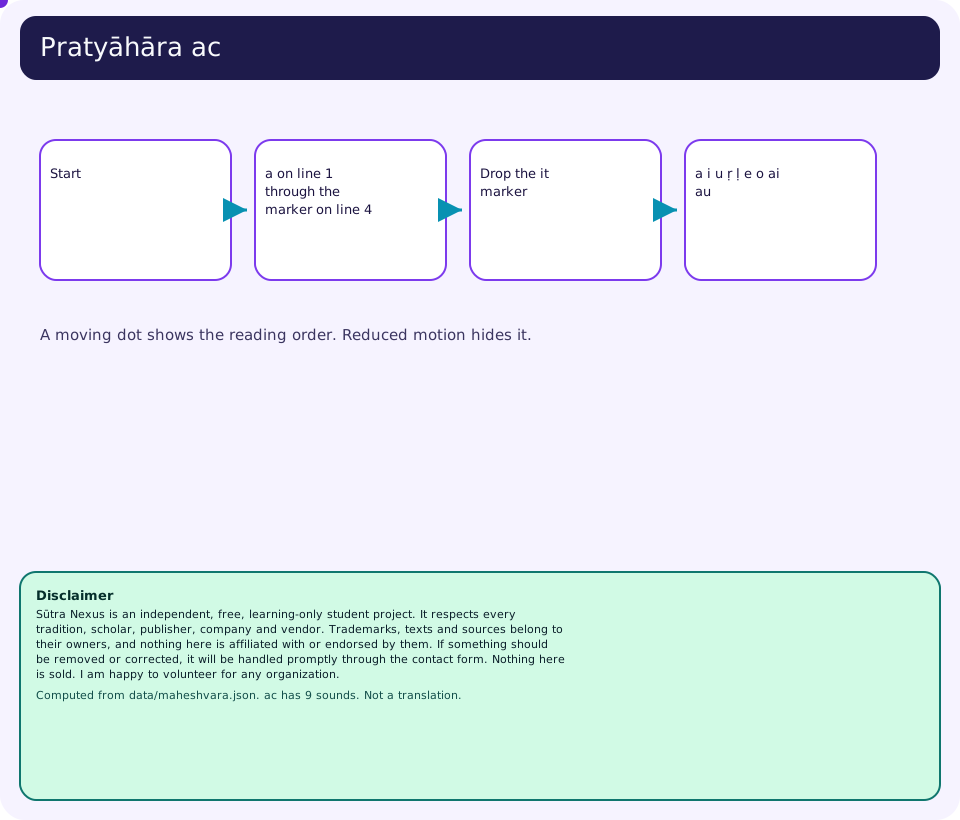
Build ac
- Start at a on line 1.
- Walk forward through lines 1, 2, 3, and 4.
- Stop at the marker on line 4. Drop every marker.
- The sounds are: a i u ṛ ḷ e o ai au.
- The same function returns 33 sounds for hal and 42 for al. You can recompute both in the builder below.
Builder
The set is computed in the browser from the 14 lines. It is not a translation.
Quiz
How many sounds does the self-test expect for hal?
How many sounds does al contain in the self-test?
Is the marker kept inside the set?
What does ac start with?
Which text is this page not?
Ecosystem
Glossary
- pratyāhāra — In this app, a set computed from a start sound and a marker line.
- it marker — The final marker on a line. The builder does not keep it in the set.
- ac — The computed set: a i u ṛ ḷ e o ai au.
Sister topics
Sandhi, foundations, play.
Bridges
A programmer can read ac as a named set. That reading is a bridge, not a claim that the tradition described software.
Later hooks
A human check of the line IAST.
Sources and go deeper
- ashtadhyayi-com/data README. The raw README says you are free to use the data in your own projects if you give appropriate credit. No SPDX identifier is stated. last checked 2026-10. Licence: credit required, no formal SPDX, confirmed from the raw README.
- English Wikipedia, Shiva Sutras (phoneme list). Short description: 14 verses organizing the phonemes of Sanskrit. The page points the Kashmir text to a different article and says it needs more citations. last checked 2026-10. Licence: CC BY-SA 4.0.